


How to Remove Microplastics from Water: A Filtration Guide
How to Remove Microplastics from Water: A Filtration Guide
When The Washington Post reported on a new Nature study in late October 2026, it reframed something a lot of us had quietly assumed: that plastic is inert, that it just "sits there" without reacting. The new research says otherwise. Here's what it means, what microplastics actually are, and how a serious multi-stage filter — like the Purewell portable RO system — puts a real barrier between them and your glass.
- The study says "associated with," not "causes": it describes a plausible mechanism (oxidative stress), not a health verdict.
- Microplastics are under 5 mm — the ones in drinking water are mostly a fraction of a micron, invisible but present.
- A 0.0001-micron RO membrane blocks them physically: any particle larger than the pores cannot pass through.
- Microplastics are not a separately certified claim on the K8680 — the benefit comes from membrane physics, not a marketing claim.

What the new study actually found
Researchers at Columbia University and UC Berkeley found that tiny microplastic particles, when exposed to water, release highly reactive oxygen species — chemically energetic molecules that can damage nearby biological molecules like proteins, DNA, and RNA. The proposed mechanism is oxidative stress: an excess of reactive molecules overwhelms the body's natural defenses, which can then trigger inflammation and other problems.
It's worth reading that finding carefully, because the honest version matters:
- The study and the reporting use "associated with" and "linked to," not "causes."
- No safe dose has been established, and the work describes elevated risk, not a verdict.
- It provides a plausible mechanism — a "how" — for earlier observations linking microplastics to cardiovascular and neurological concerns.
The practical takeaway isn't panic. It's that invisible contaminants in water deserve the same attention as the visible ones.
What are microplastics, and where do they come from?
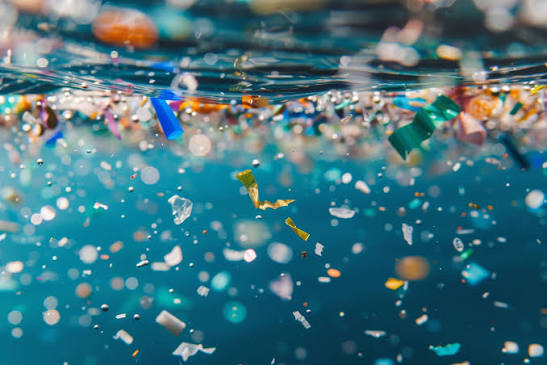
Microplastics are small plastic particles, generally defined as less than 5 millimeters. Most of the ones that end up in drinking water are far smaller — a fraction of a millimeter, or smaller than a grain of sand. They come from many everyday sources:
- Breakdown of larger plastic waste (bottles, bags, packaging)
- Synthetic clothing fibers shed during washing
- Tire wear and road runoff
- Microbeads and industrial pellets

Because they're so widespread, microplastics have been detected in tap water, bottled water, rivers, lakes, and even rainfall. The question isn't whether they're present; it's how much, and what your exposure looks like over time.
The filtration question: can a filter remove microplastics?
This is where the type of filter matters enormously. The key distinction is between what a filter catches physically and what it can remove at the molecular level.
Basic sediment and mesh filters are typically rated in the 5–50 micron range. They catch visible debris — sand, rust, larger particles — but most microplastics are far smaller than those pores, so a basic filter lets them pass through.
Reverse osmosis (RO) membranes work on an entirely different scale. A high-precision RO membrane has pores measured in fractions of a micron — for the Purewell system, 0.0001 microns. For perspective:
- A human hair is roughly 70 microns wide.
- Most microplastics fall between 1 micron and 5 millimeters.
- A 0.0001-micron membrane is therefore thousands of times finer than the particles it needs to block.
Because a microplastic particle is physically larger than the membrane's pores, it cannot pass through the membrane — it's retained on the feed side and flushed away with the waste water. This is a physical property of the filtration, not a marketing claim: particles bigger than the pore size get blocked.
Inside the multi-stage filtration: how the K8680's 10 stages work
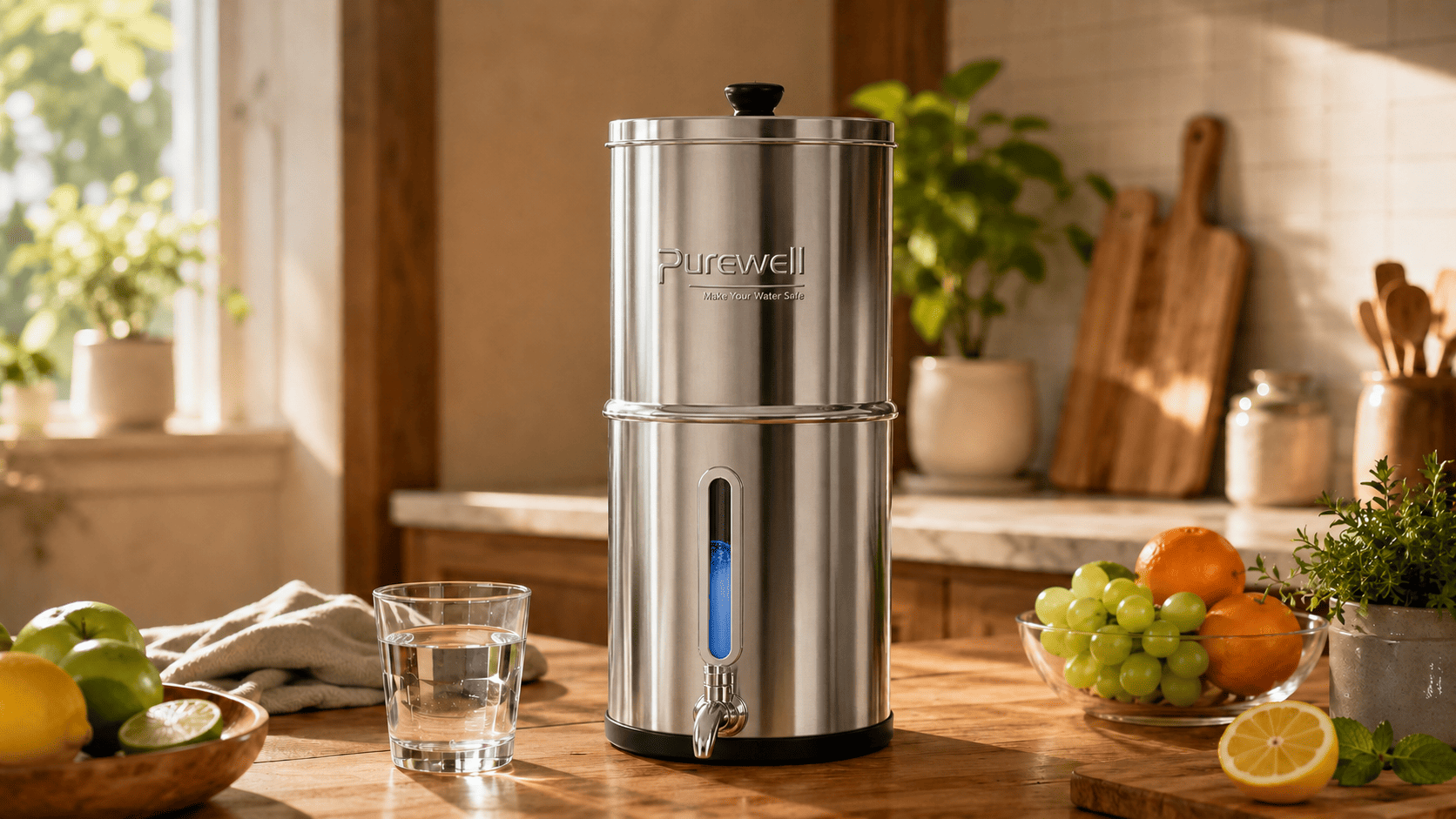
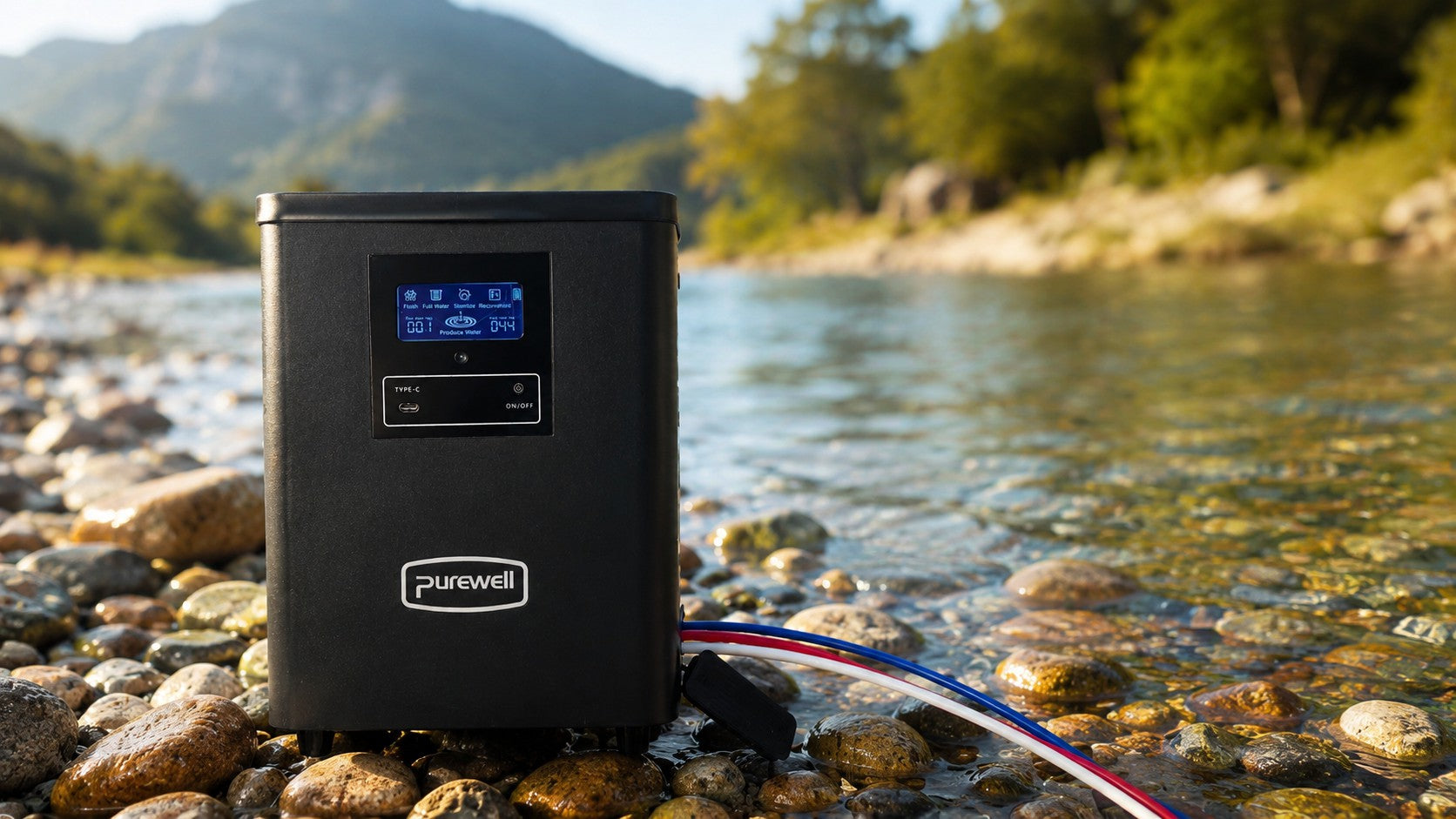
The Purewell Portable RO Water Purifier (model K8680) doesn't rely on a single filter to do one job. It runs water through a 10-stage filtration path — which, in practical terms, rolls up into four defensive layers, each catching what the last one left behind.

| Layer | What it removes | Why it matters for microplastics |
|---|---|---|
| 1. Pre-filter (PP cotton) | Visible sediment, rust, insect eggs, mineral debris (>5 µm) | Protects the membrane from large debris so it stays sharp for the fine stuff |
| 2. Activated carbon | Chlorine, taste, odor, synthetic detergents, selected organics | Improves taste and pulls out dissolved organics |
| 3. RO membrane (0.0001 µm) | Dissolved solids, heavy metals — and anything larger than its pores | The core barrier: physically blocks microplastics far larger than 0.0001 microns |
| 4. UV disinfection | Adds a final disinfection stage | A second line of defense after physical filtration |

The point of stacking these stages isn't marketing theater. Each layer extends the life of the one after it, and together they cover the full spectrum: big particles, dissolved chemicals, and sub-visible particulates like microplastics. A single-stage pitcher simply can't do all four.
The specs that make it practical every day

Filtration precision only matters if the unit actually fits your life. Here's how the K8680's specs translate to daily use:
| Feature | Purewell value | What it means for you |
|---|---|---|
| Filtration | 10-stage, 0.0001-micron RO membrane | Real barrier against microplastics and dissolved contaminants |
| Power | 5,200 mAh battery or plug-in | Works on the counter or off-grid |
| Runtime | Up to 6.5 hours | Covers multi-day use on a charge |
| Flow rate | 400 ml/min | Fills a glass in about 38 seconds |
| Pure-to-waste ratio | 2:1 | Less water wasted than many RO units |
| Footprint | 240 × 125 × 315 mm, 9.3 lb | Compact, no permanent install needed |
| Price | $249.00 (current) | Whole-home RO precision without whole-home cost |


Why this is the filter to shortlist
If you're weighing options for microplastics and general water quality, the K8680 checks the boxes that actually matter:
- Precision where it counts. A 0.0001-micron RO membrane is in a different class from a "micron-rated" sediment filter — it's built to stop what a basic filter lets through.
- Layered, not single-stage. Four defensive layers (pre-filter → carbon → RO → UV) mean no single point of failure.
- Portable without the compromise. You get RO-grade purification without a permanent under-sink install — ideal if you rent, move, or want one device for home and travel.
- Honest about limits. The tested claims are documented (SGS report via QR), and we tell you plainly where the physics ends and the certification begins.
Purewell Portable RO Water Filter System
10-stage filtration · 0.0001-micron RO membrane · UV treatment · 5,200 mAh with up to 6.5 h runtime · 400 ml/min flow · 2:1 pure-to-waste ratio · compact 240 × 125 × 315 mm, 9.3 lb. Complete system from $249.00 (current price — check the product page, prices change).
View the portable RO purifier in the US storeWhat to look for in a microplastics filter
- Check the pore size. Look for sub-micron or RO-grade filtration. "Micron-rated" sediment filters are not the same as a 0.0001-micron membrane.
- Ask what's tested. A documented test report beats a vague claim. Read what contaminants the report actually covers.
- Separate physical and certified claims. RO membranes block particles larger than their pores (physics); a certified removal claim is a specific, tested statement.
- Match the unit to your life. Portable RO gives you precision without a permanent install.
Frequently asked questions
Do all water filters remove microplastics?
No. Basic sediment and mesh filters (5–50 micron) let most microplastics through. Reverse osmosis membranes with sub-micron pores — like a 0.0001-micron membrane — physically block particles far larger than the pores, which includes microplastics.
Does the new study mean I should filter my water?
It reinforces that invisible contaminants deserve attention, but it's a study about risk association, not a verdict. Filtering is a reasonable precaution; the study isn't a reason to panic.
Is the microplastics claim certified on the Purewell system?
The system's documented test report focuses on PFAS and other listed contaminants; microplastics are not a separately certified claim. The microplastics benefit comes from the physics of the 0.0001-micron membrane blocking particles larger than its pores.
How many stages does the K8680 filter through?
It's a 10-stage path that rolls up into four functional layers: PP cotton pre-filter, activated carbon, a 0.0001-micron RO membrane, and UV disinfection. Each layer handles a different job before water reaches the clean outlet.
Does the Purewell portable RO purifier need electricity?
It runs on a built-in 5,200 mAh battery (up to about 6.5 hours) or can be plugged in, so it works at home and off-grid.
Related guides