
How to Choose the Best Well Water Filter for Your Home

Searching for a well water filter can quickly become confusing.
Some products are designed mainly for sediment. Others address hardness, iron, bacteria, nitrate, arsenic, taste, odor, or dissolved minerals. A filter that works well for one private well may be unsuitable for another well only a few miles away.
That is because private well water is not treated and monitored in the same way as water supplied by a public utility. Well owners are generally responsible for testing their water, maintaining the well, and selecting treatment for the specific conditions found on their property. Around 15% of the U.S. population relies on private wells, and an EPA-cited study found that approximately one in five tested wells contained at least one contaminant above a drinking-water health benchmark.
The best well water filter is therefore not the system with the largest contaminant list. It is the treatment setup that matches your laboratory results, source-water condition, household demand, and intended use.
This guide explains how to test well water, match common problems to appropriate treatment technologies, and determine when a Purewell countertop gravity water filter can serve as a practical point-of-use solution.
Table of Contents
-
Why well water requires a different buying approach
-
Test your water before choosing a filter
-
Common well water problems
-
Match the treatment to the test result
-
Whole-house vs. point-of-use filtration
-
Can a gravity filter be used with well water?
-
When a Purewell gravity system may be a good fit
-
When a gravity filter is not enough
-
Choosing the right Purewell system size
-
Well water filter maintenance
-
Buying checklist
-
Frequently asked questions
Why Well Water Requires a Different Buying Approach
Public water systems normally use multiple treatment steps and routinely monitor regulated water-quality parameters. Private wells are different: federal public drinking-water rules generally do not regulate, treat, or routinely monitor privately owned wells.
Two wells can have different problems because of differences in:
-
Local geology
-
Well depth and construction
-
Nearby septic systems
-
Agricultural activity
-
Flooding and surface runoff
-
Mining or industrial activity
-
Household plumbing
-
Seasonal groundwater conditions
Possible concerns may include microorganisms, nitrate, arsenic, lead, iron, manganese, hardness, sediment, volatile organic compounds, radionuclides, fluoride, or other locally relevant substances. EPA notes that contaminants can enter wells through groundwater movement, surface seepage, runoff, waste disposal, flooding, industrial activity, and naturally occurring mineral deposits. (US EPA)
Because these issues require different treatment methods, the phrase “well water filter” does not describe one universal product category.
Test Your Well Water Before Buying a Filter
Testing should be the first step—not something completed after the filtration system is installed.
CDC recommends testing private well water at least annually for:
-
Total coliform bacteria
-
Nitrate
-
Total dissolved solids
-
pH
Well owners should also ask their local health or environmental department which additional germs or chemicals are relevant in their area and use a state-certified laboratory.
Additional testing may be appropriate for:
-
Lead
-
Arsenic
-
Mercury
-
Radium
-
Pesticides and herbicides
-
Volatile organic compounds
-
Iron and manganese
-
Hardness
-
Sulfate or chloride
-
Other local contaminants
Retesting is also recommended after flooding, well repairs, noticeable changes in taste or color, nearby land disturbance, or another event that could affect the well.
Do Not Buy Based Only on Appearance
Clear water is not proof that a well is free from contamination.
Nitrate, arsenic, lead, bacteria, and many other substances may not create an obvious taste, smell, or color. Conversely, staining or a mineral taste may be caused by an aesthetic water-quality issue rather than the most serious contaminant present.
A laboratory report provides a far better foundation for choosing treatment than a visual inspection or a basic TDS meter.
Common Well Water Problems
Sediment and Turbidity
Sand, silt, clay, rust, and other suspended particles can make water cloudy and clog treatment equipment.
Heavy sediment can also reduce the flow and service life of a countertop filter. When source water is visibly cloudy, a sediment pre-filter or another point-of-entry treatment stage may be needed before drinking-water filtration.
Bacteria and Other Microorganisms
Coliform bacteria can indicate that a well is vulnerable to contamination. Other microorganisms may enter through flooding, damaged well construction, surface runoff, or nearby waste sources.
A contaminated well should not be treated as an ordinary taste-and-odor problem. CDC advises people not to drink suspected contaminated well water and to use bottled water or another safe source until the cause is addressed, treatment is completed, and testing confirms that the treatment worked.
Nitrate
Nitrate may enter groundwater from fertilizer, animal waste, septic systems, wastewater, storm runoff, and natural conditions.
Activated carbon filters do not normally remove nitrate. Treatment may require a verified reverse osmosis, distillation, ion-exchange, or other system specifically designed for nitrate reduction.
Iron and Manganese
Iron and manganese may cause staining, discoloration, metallic taste, or deposits.
Depending on concentration and water chemistry, treatment may involve oxidation, aeration, specialized media, filtration, or a properly selected water softener. Ordinary countertop carbon filtration may improve selected taste characteristics but is not automatically a complete iron-removal solution. (US EPA)
Hardness
Calcium and magnesium cause water hardness, scale, soap-lather problems, and deposits in appliances.
A conventional water softener is designed to treat hardness throughout the home. A standard gravity carbon or ultrafiltration system generally does not soften water or prevent scale in household plumbing. (US EPA)
Arsenic, Lead, and Other Dissolved Contaminants
Dissolved contaminants require treatment verified for the exact substance.
Reverse osmosis can reduce certain dissolved chemicals, potentially including arsenic, nitrate, lead, fluoride, calcium, and magnesium, but buyers must check the exact certified reduction claims of the selected system.
Taste and Odor
Unpleasant taste or odor may be associated with sulfur compounds, iron, manganese, natural organic matter, plumbing, or another condition.
Activated carbon is commonly used for specified taste, odor, and chlorine concerns. NSF/ANSI 42 applies to certified aesthetic-reduction claims, but it does not automatically prove reduction of health-related contaminants.
Match the Treatment to the Test Result
The following table provides a practical starting point. Final treatment should be based on laboratory results, concentration, flow requirements, and guidance from a qualified well-water professional.
| Test Result or Problem | Common Treatment Starting Point | Role of a Countertop Gravity Filter |
|---|---|---|
| Sand, silt, heavy sediment | Whole-house sediment filtration | Useful after sediment is controlled |
| Coliform bacteria | Well repair, disinfection, UV or another verified microbial treatment | Should not be assumed to replace primary disinfection |
| High nitrate | Certified nitrate-reduction system, often RO or ion exchange | Standard carbon filters are not suitable |
| Hardness | Whole-home water softener | Does not normally soften water |
| Iron or manganese | Oxidation, aeration, specialized media or properly selected softening | May clog quickly if used without pretreatment |
| Arsenic or lead | Treatment certified for the exact contaminant | Use only when the filter has the relevant verified claim |
| High TDS | RO, distillation or another dissolved-solids treatment | Standard K Series filters do not reduce TDS |
| Taste, odor or light sediment | Activated carbon and applicable filtration media | May be a suitable point-of-use option |
| Clear, tested well water | Treatment based on the identified concern | Gravity filtration may provide convenient drinking and cooking water |
CDC emphasizes that no single home treatment method protects against every well-water problem. The chosen system should specifically address the germ or chemical identified through testing.
Whole-House vs. Point-of-Use Well Water Filtration
A major purchasing decision is whether the problem should be treated before water enters the home or only at the drinking-water point.
Point-of-Entry Treatment
A point-of-entry system treats water before it moves throughout the house.
This is generally more appropriate for concerns affecting:
-
Showers and bathing
-
Laundry
-
Water heaters
-
Appliances
-
All faucets
-
Household plumbing
Examples include hardness, heavy sediment, significant iron, manganese, and some microbial treatment setups.
Point-of-Use Treatment
A point-of-use system treats water at one location, usually for drinking and cooking.
Examples include:
-
Countertop gravity filters
-
Countertop RO systems
-
Under-sink filters
-
Faucet filters
-
Filter pitchers
A point-of-use filter may be a practical choice when the well has already been tested and the goal is to address a documented drinking-water concern or improve selected taste and odor characteristics.
Many homes use both approaches: primary whole-house treatment for the source-water problem, followed by a countertop or under-sink system for drinking water.
Can a Gravity Water Filter Be Used With Well Water?
A gravity water filter can be used with some well water, but only under the right conditions.
It is most appropriate when:
-
The well has been tested.
-
The water is clear rather than heavily turbid.
-
Any major microbial, sediment, hardness, iron, or chemical problem has been properly addressed.
-
The installed filter’s verified claims match the remaining concern.
-
The user understands that filter life may be shorter with untreated source water.
Purewell lists well water among the potential source-water types for its current K Series systems but also states that source-water quality affects flow and filter life. The company recommends using clear source water and warns that well or untreated water may shorten service life. (Purewell)
A gravity system should not be purchased with the assumption that it automatically converts every untreated well into safe drinking water.
When a Purewell Gravity System May Be a Good Fit
A Purewell gravity filter can provide a practical point-of-use solution for tested well water when the selected filter configuration matches the household’s needs.
Everyday Drinking and Cooking Water
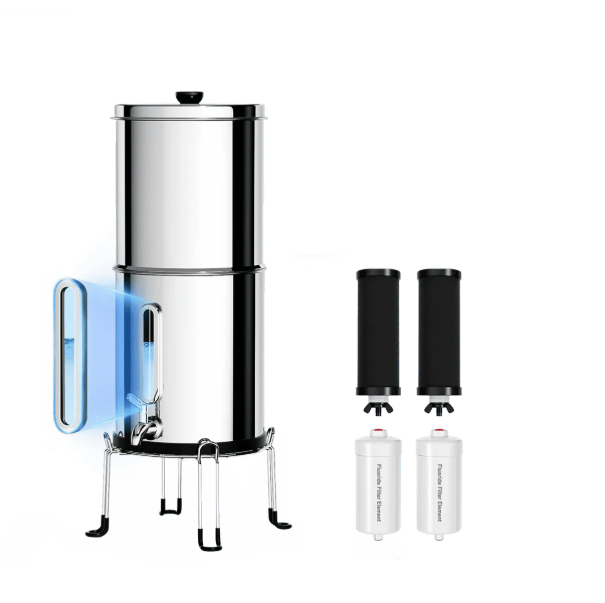
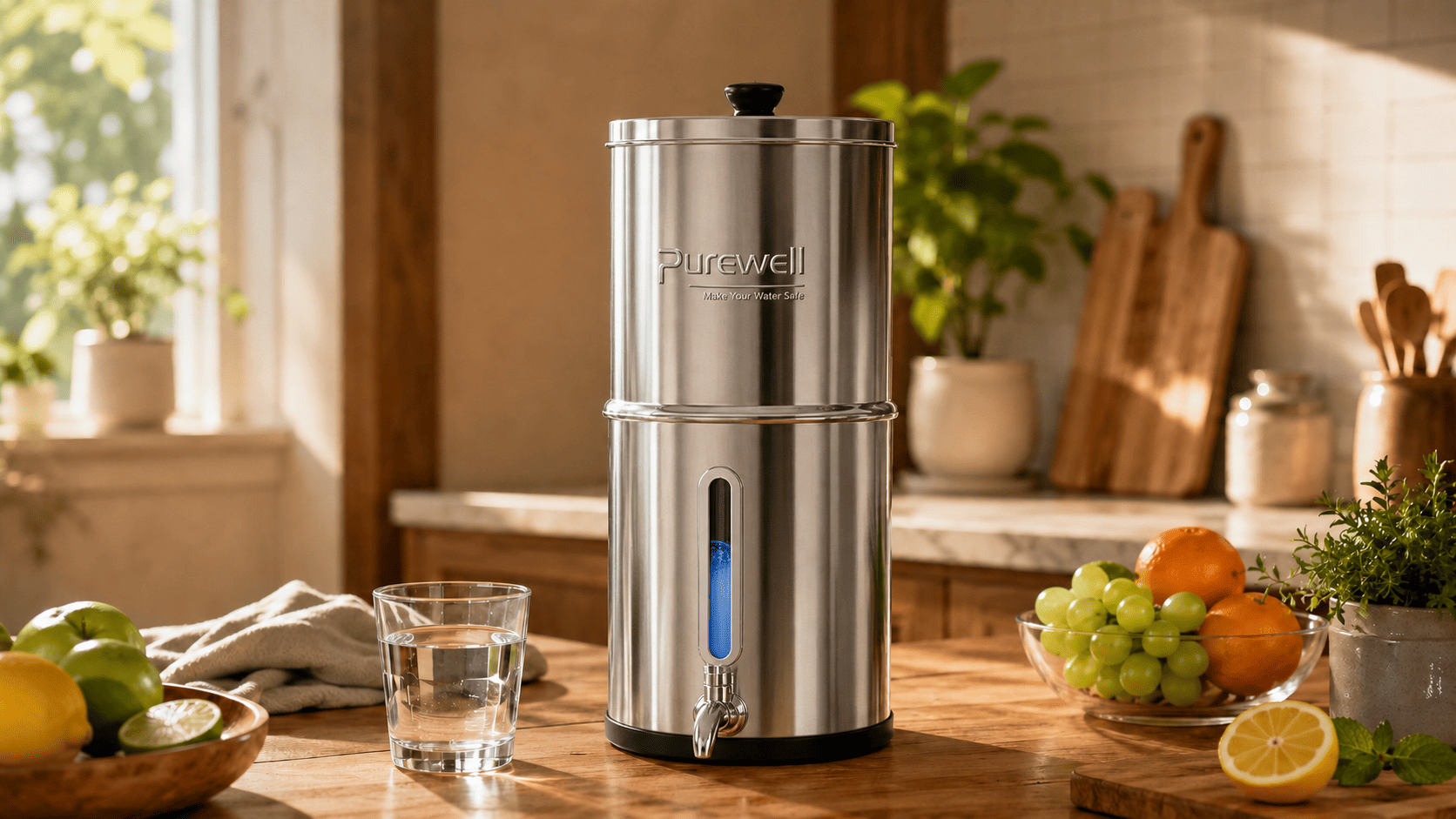
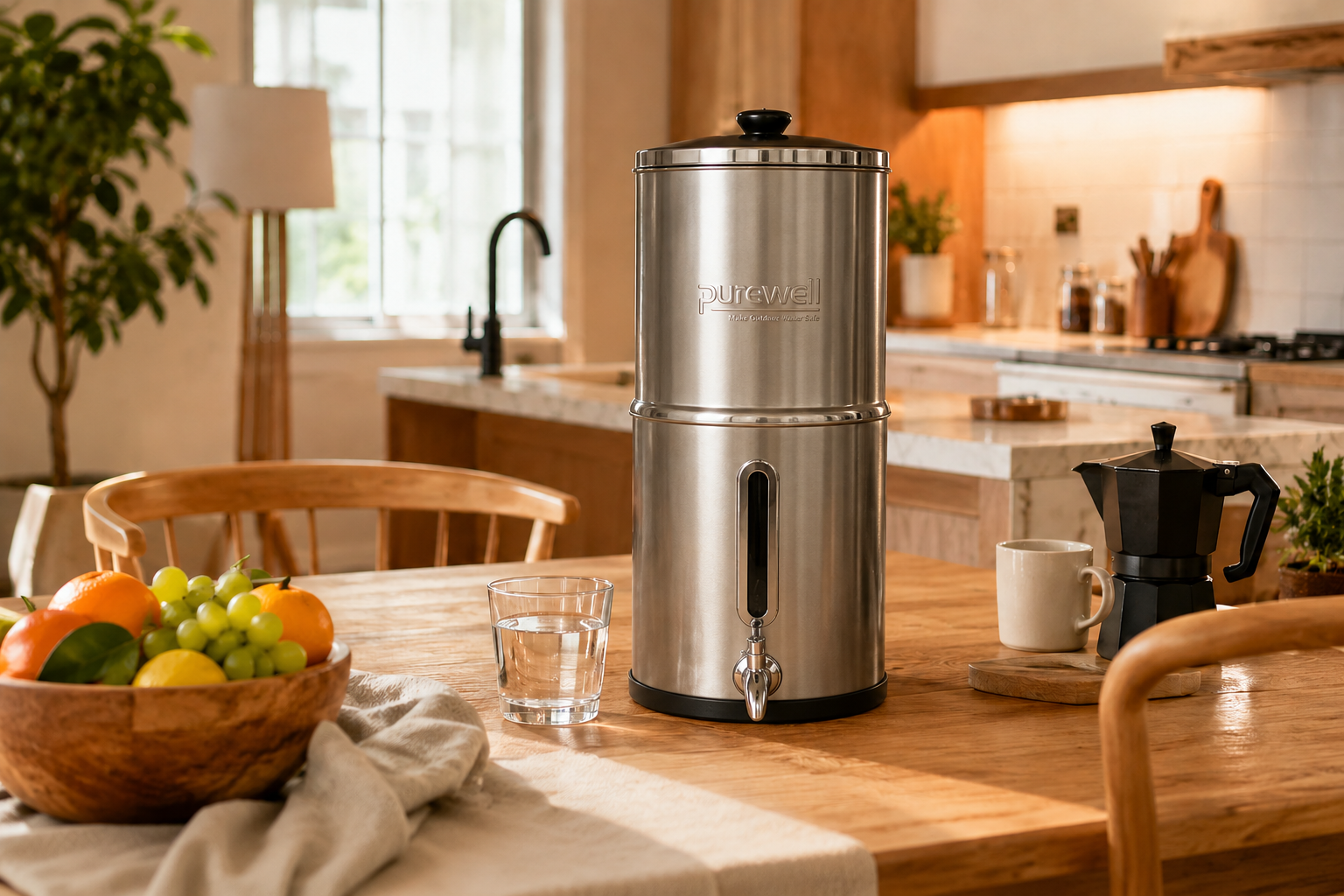
The Purewell K Series 2.25 Gallon system is designed for approximately three to five users and includes:
-
304 stainless steel chambers
-
A built-in water-level window
-
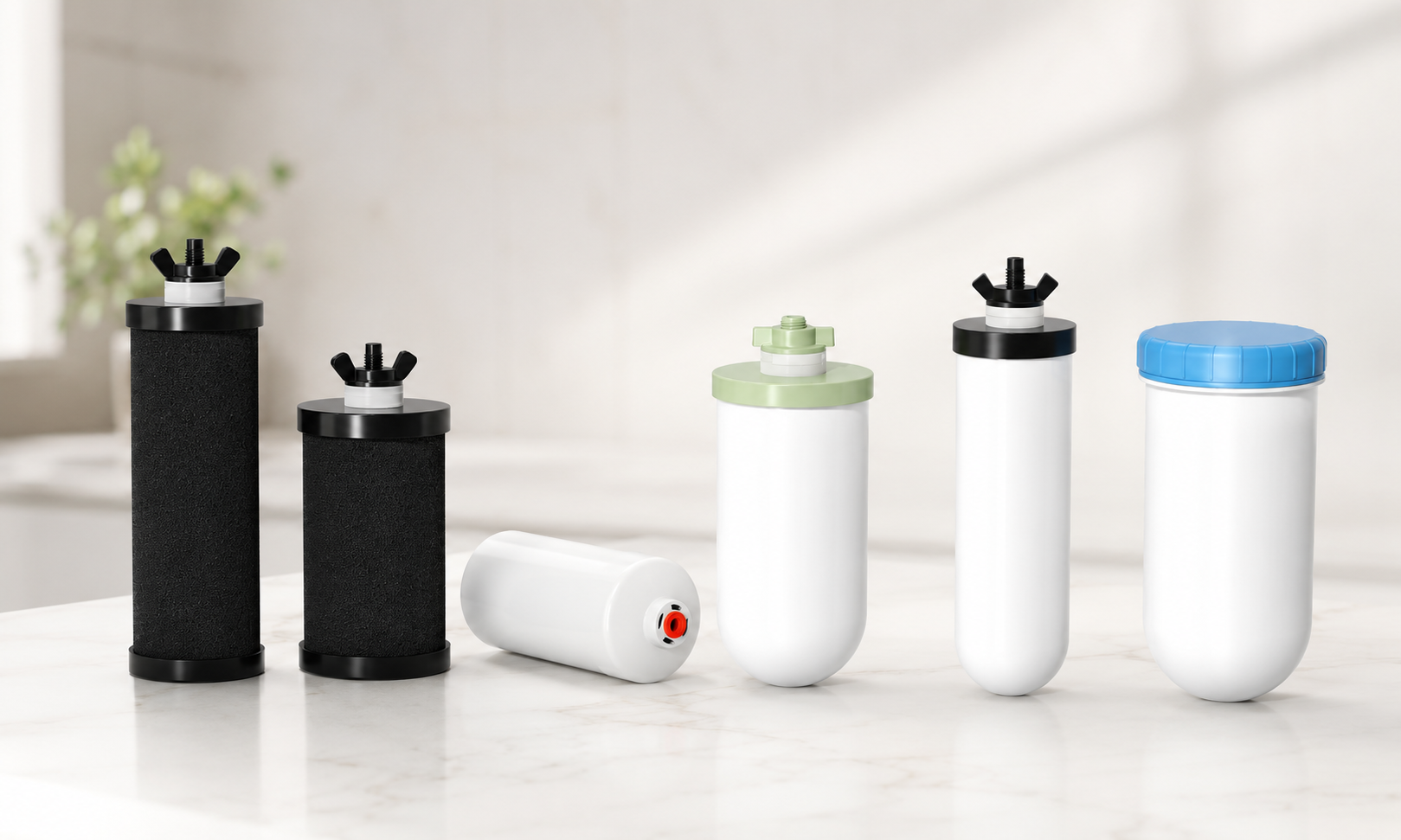
Two compatible K Series filters
-
Up to four gallons per hour under the stated conditions
-
A rated capacity of up to 6,000 gallons per two-filter box
-
Electricity-free gravity operation
The standard K Series filter combines activated carbon, silver-ion material, and a hollow-fiber UF membrane. It is not designed to reduce total dissolved solids. (Purewell)
This type of system may suit a well-water household that wants:
-
A separate supply for drinking and cooking
-
No permanent plumbing modification
-
No electricity during normal filtration
-
Visible filtered-water storage
-
A countertop system for home, cabin, or RV use
Match the Filter Configuration Carefully
Selected K Series options include everyday carbon, fluoride-reduction, and alkaline configurations. Filter options should be selected according to the well test and the supporting performance documentation, not simply according to the number of stages. (Purewell)
Purewell publishes applicable material evaluations and third-party performance reports for selected products and test conditions. Each report applies only to the sample, configuration, tested volume, and claim described in that document. (Purewell)
When a Gravity Filter Is Not Enough
A countertop gravity system should not be the only treatment when testing identifies:
-
Significant bacterial contamination
-
Viruses requiring disinfection
-
High nitrate
-
Arsenic outside the filter’s verified scope
-
Severe iron or manganese
-
Heavy sediment
-
High hardness affecting the entire home
-
Fuel, solvent, or industrial contamination
-
Radionuclides
-
Saltwater intrusion
-
Another contaminant requiring specialized treatment
For microbial concerns, UV systems with appropriate pre-filtration can reduce bacteria, parasites, and viruses, but UV does not remove chemical contaminants.
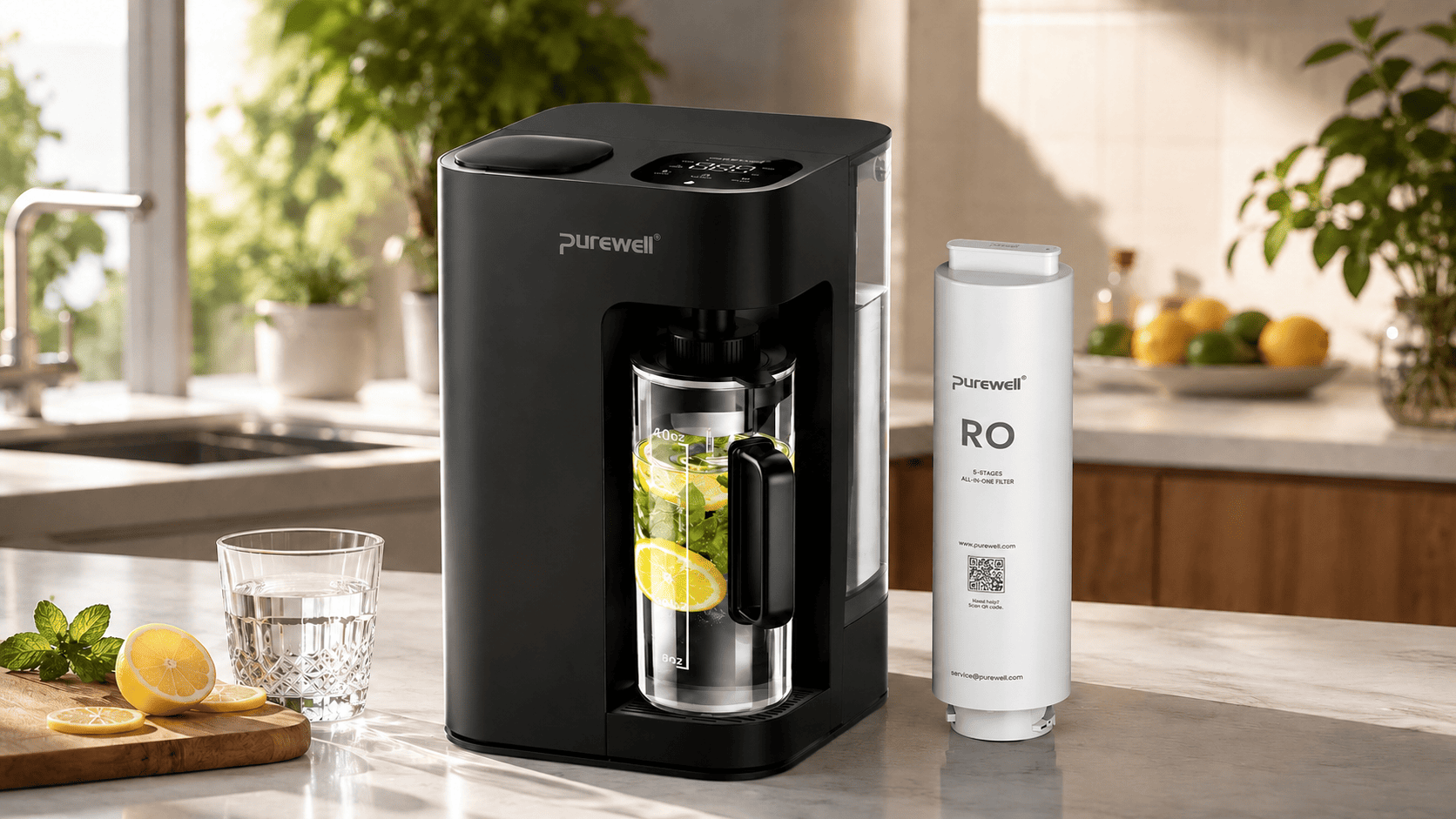
For dissolved chemicals, RO may be appropriate when the selected system is certified for the contaminant. However, buyers should not assume that every countertop RO unit accepts raw well water. Purewell’s current C05 system, for example, specifies municipal tap water and advises against feed water above 500 ppm TDS, so it should not be presented as a direct untreated-well solution. (Purewell)
When the well is contaminated or the treatment needs are complex, work with a local health department, certified laboratory, well contractor, or qualified water-treatment professional.
Choosing the Right Purewell System Size
After confirming that gravity filtration is appropriate, choose capacity according to daily water use.
| Household Size | Suggested Purewell Starting Point | Typical Use |
|---|---|---|
| 1–2 people | K Series 1.0 Gallon | Compact kitchens, couples, cabins or RVs |
| 2–3 people | K Series 1.5 Gallon | Moderate daily drinking and cooking |
| 3–5 people | K Series 2.25 Gallon | Family use, meals, reusable bottles and guests |
Purewell positions its 1.0-gallon model for one to two users, the 1.5-gallon model for two to three users, and the 2.25-gallon model for three to five users. Actual suitability depends on how often the household cooks, fills bottles, serves guests, and refills the upper chamber. (Purewell)
For a family relying on the system for most drinking and cooking water, the 2.25-gallon model is generally the most flexible Purewell starting point.
Well Water Filter Maintenance
Well water can place a greater load on filtration media than clear municipal tap water.
Monitor Flow Rate
A gradual reduction in flow may indicate sediment buildup, trapped air, low upper-chamber water level, or a filter approaching replacement.
Follow the approved cleaning and troubleshooting steps. Replace the filter when normal flow cannot be restored or when its rated service limit is reached.
Track Filter Use
Record:
-
Installation date
-
Exact filter model
-
Rated gallon capacity
-
Approximate daily use
-
Cleaning dates
-
Water-test results
-
Changes in flow, taste, or odor
Do not rely only on a general six- or twelve-month schedule.
Retest the Well
A filter does not remove the need for ongoing well testing.
Continue annual testing and test again after flooding, repairs, land disturbance, water-quality changes, or another event that could affect the well.
Replace Matched Filters Together
When a Purewell system uses two matched core filters, install and replace both as directed. This keeps filter age, flow, and capacity tracking consistent. (Purewell)
Well Water Filter Buying Checklist
Before purchasing, confirm the following.
Water Testing
-
Has the well been tested by a certified laboratory?
-
Are coliform, nitrate, TDS, and pH results current?
-
Were locally relevant contaminants included?
-
Has the water changed since the last test?
Treatment Goal
-
Sediment control
-
Microbial treatment
-
Hardness reduction
-
Iron or manganese treatment
-
Nitrate or arsenic reduction
-
Taste and odor improvement
-
Point-of-use drinking-water filtration
System Compatibility
-
Does the filter have a verified claim for the concern?
-
Is the water clear enough for the system?
-
Does the product accept well water?
-
Is pretreatment required?
-
Does the filter reduce TDS, or does it specifically state that it does not?
Household Fit
-
Daily drinking and cooking demand
-
Number of users
-
Countertop and cabinet clearance
-
Filter flow rate
-
Replacement-filter availability
-
Ongoing maintenance cost
A good purchase begins with the laboratory report, not the product page.
Summary: What Is the Best Well Water Filter?
There is no single best filter for every private well.
The correct system depends on what the water test identifies:
-
Use sediment treatment for heavy particles.
-
Use a softener for whole-home hardness.
-
Use appropriate oxidation or media for iron and manganese.
-
Use verified disinfection for microbial contamination.
-
Use certified treatment for nitrate, arsenic, lead, or other dissolved contaminants.
-
Use a gravity filter when the source water is clear, tested, and compatible with the filter’s documented functions.
For families that need convenient point-of-use drinking and cooking water, the Purewell K Series 2.25 Gallon system may be a practical option after testing and any necessary pretreatment. It offers stainless steel construction, electricity-free operation, family-size capacity, a water-level window, and replaceable filter configurations. (Purewell)
The most responsible path is simple:
Test first. Treat the identified problem. Then choose the countertop filter that fits your family’s daily routine.
Frequently Asked Questions
What is the best filter for well water?
The best filter depends on the laboratory results. Sediment, hardness, bacteria, nitrate, iron, arsenic, and taste problems require different treatment methods.
How often should private well water be tested?
CDC recommends annual testing for total coliform bacteria, nitrate, TDS, and pH, plus additional locally relevant contaminants. Retesting is also appropriate after flooding, repairs, or noticeable water changes.
Can a gravity filter make well water safe?
Not in every situation. A gravity filter may address documented concerns within its performance scope, but it should not be assumed to solve every microbial or chemical problem.
Can Purewell gravity filters be used with well water?
Purewell lists well water as a possible source for applicable K Series systems, while warning that source-water quality can affect flow and filter life. Clear, tested water is recommended. (Purewell)
Does a gravity filter remove nitrate?
Standard activated-carbon gravity filters do not normally remove nitrate. Choose a system specifically certified for nitrate reduction.
Does a Purewell K Series filter reduce TDS?
No. The current K Series product specifications state that these filters are not designed to lower total dissolved solids. (Purewell)
Does a gravity filter soften hard well water?
No. Standard gravity carbon and UF filters generally do not remove the dissolved calcium and magnesium responsible for hardness. A water softener is designed for that purpose. (US EPA)
What should I do if bacteria are found in my well?
Stop using the water for drinking, use another safe source, contact the appropriate local authority or well professional, complete the recommended repair and treatment, and retest before resuming use.
Should I use a whole-house system or countertop filter?
Whole-house treatment is generally more suitable when the issue affects plumbing, appliances, showers, and every faucet. A countertop filter treats only drinking and cooking water at one location.
Choose a Gravity Filter for Tested Well Water
After reviewing your well-water test and completing any necessary primary treatment, explore Purewell gravity systems for convenient point-of-use filtration.
Editorial Disclaimer
This article provides general educational and product-selection information. Private well conditions vary widely. Testing, treatment selection, installation, and follow-up testing should reflect the contaminants and concentrations found in the specific well. A countertop gravity filter should not replace professional treatment or official health guidance when well water is contaminated.