
How to Choose the Best Gravity Water Filter for Your Family
The best gravity water filter is not necessarily the largest system, the most expensive model, or the one with the longest list of filtration claims.
It is the system that matches your household’s water source, daily water demand, available countertop space, filtration priorities, and willingness to maintain the filters.
A couple living in an apartment may find a compact 1.0-gallon system more convenient than a large family-size unit. A household of four that regularly uses filtered water for drinking, cooking, coffee, and pets may prefer a 2.25-gallon model. A family concerned about one specific substance should focus on the exact filter configuration and supporting documentation rather than buying on capacity alone.
This guide explains how to compare gravity water filters by household size, capacity, filter structure, construction material, replacement requirements, and everyday usability. It also introduces the main Purewell system options for families seeking an electricity-free countertop filtration system.
Table of Contents
-
How does a gravity water filter work?
-
Start with your household water source
-
Choose capacity based on actual water use
-
What size gravity water filter does your family need?
-
Compare filter types and filtration goals
-
Why system material matters
-
Check flow rate and filter quantity
-
Look for practical everyday features
-
Calculate the long-term ownership cost
-
Purewell gravity water filter recommendations
-
Common buying mistakes
-
Final buying checklist
-
Frequently asked questions
How Does a Gravity Water Filter Work?
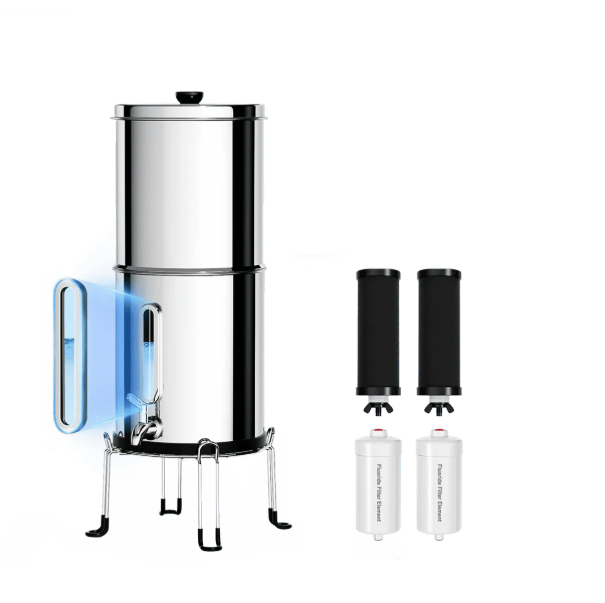
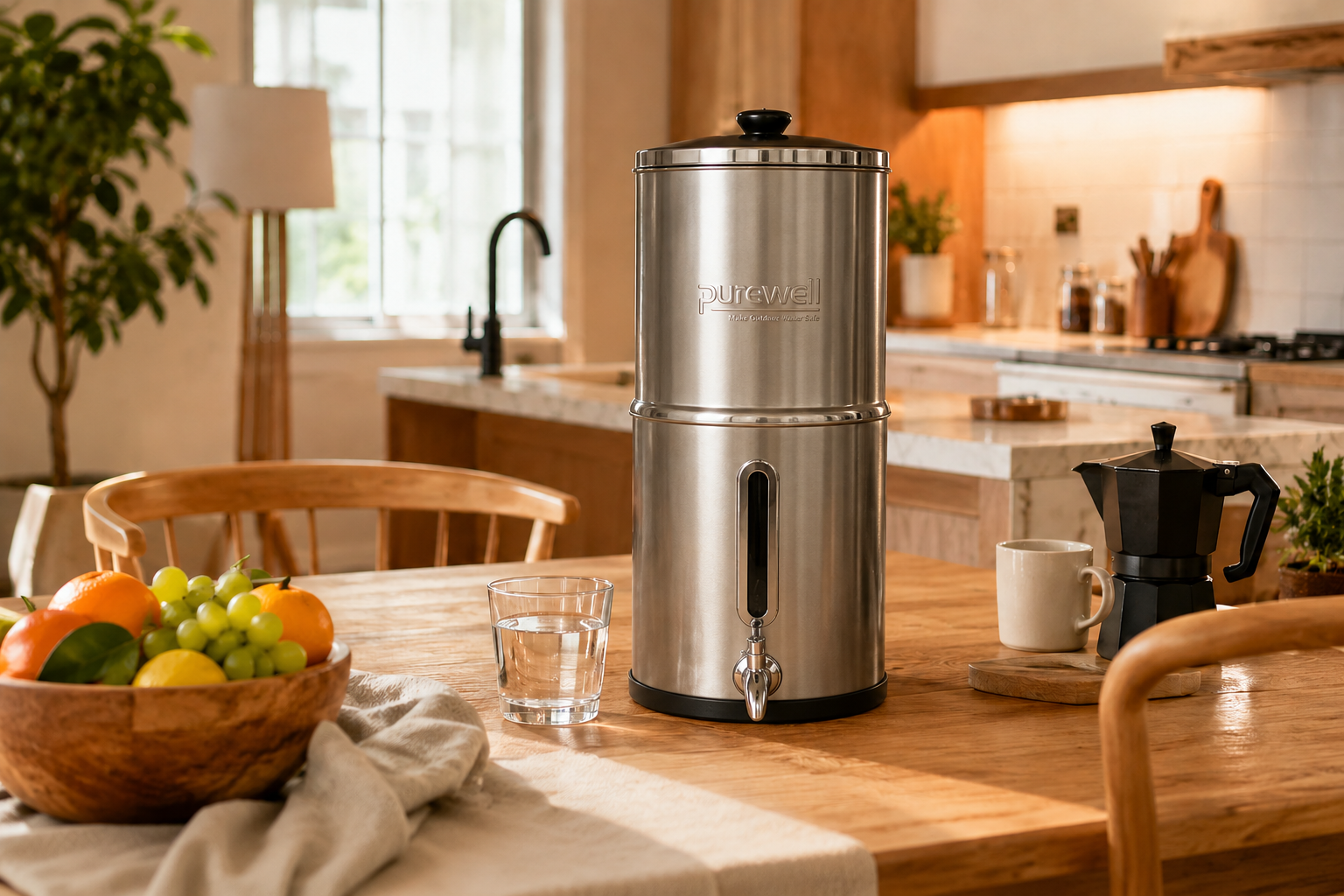
A countertop gravity water filter normally has two chambers.
Water is poured into the upper chamber, where one or more filter elements are installed. Gravity moves the water downward through the filters, and the treated water collects in the lower chamber. It can then be dispensed through a spigot.
This type of system generally does not require:
-
A permanent plumbing connection
-
Household water pressure
-
Electricity during filtration
-
Installation beneath a sink
That makes gravity systems practical for many kitchens, apartments, rental homes, cabins, RVs, and emergency-preparedness setups.
However, gravity filtration is usually slower than a pressurized system. Flow can also change as the upper chamber empties, as sediment collects on the filters, or as the elements approach their replacement point.
The goal is not simply to buy the fastest system. A family should balance flow rate with capacity, filter performance, maintenance, and available space.
Start With Your Household Water Source
Before comparing system sizes or designs, identify where your drinking water comes from.
Public Tap Water
Families using a public water system should begin with their local Consumer Confidence Report. Community water systems provide these annual reports to help customers understand their source water, detected substances, treatment, and compliance with applicable drinking-water requirements. (US EPA)
Your report can help answer an important question:
What do you actually want the filter to address?
Possible priorities may include:
-
Chlorine taste or odor
-
Visible sediment
-
A specific substance identified in the water report
-
Water used for drinking and cooking
-
A preference for a particular filter structure
Do not choose a filter only because its marketing page contains a long contaminant list.
Private-Well Water
Private-well owners are responsible for testing and managing their own water. Federal public-water requirements do not apply to privately owned wells in the same way they apply to community systems.
Testing should come before filter selection. Depending on the results, a household may need sediment treatment, disinfection, water softening, reverse osmosis, or another solution beyond an ordinary countertop gravity system.
Rainwater and Outdoor Water
Untreated rain, stream, river, and lake water can present different risks from treated municipal water.
A product page may list several possible source-water types, but that does not mean one filter configuration addresses every possible microorganism or chemical. Source-water conditions can also reduce filter life and slow flow. Purewell therefore advises using the clearest available source water and checking the specifications for the selected filter. (Purewell)
CDC guidance recommends testing or understanding the water and selecting a filter designed for the specific germs or chemicals of concern. Different filters perform different functions, and some hazards require another treatment method.
Choose Capacity Based on Actual Water Use
Capacity is often the first specification families compare, but it can be misunderstood.
A 2.25-gallon capacity normally refers to the amount the lower chamber can hold. It does not mean the system can process only 2.25 gallons in one day. After water is dispensed, the upper chamber can be refilled and another batch can be filtered.
When estimating the capacity your family needs, consider water used for:
-
Drinking
-
Coffee and tea
-
Cooking
-
Filling reusable bottles
-
Making ice
-
Pet bowls
-
Guests
-
Emergency storage rotation
Two families with the same number of people may have very different usage.
A household of four that filters only drinking water may use less than a couple that cooks at home, works remotely, fills several bottles, and makes multiple pots of coffee each day.
Measure Before You Buy
For three to five days, estimate how much water the household would actually run through the system.
A practical method is to record:
-
Water used for drinking
-
Water used for cooking
-
Bottles filled before work or school
-
Water served to guests or pets
-
Extra use during weekends
This estimate is more useful than choosing solely by family size.
What Size Gravity Water Filter Does Your Family Need?
Purewell currently offers K Series systems in three main family-oriented capacities. Manufacturer household recommendations are useful starting points, but they are not fixed limits.
| Household Situation | Suggested Starting Capacity | Purewell Option |
|---|---|---|
| One person or a couple | 1.0 gallon | K Series 1.0 Gallon |
| Two to three people | 1.5 gallons | K Series 1.5 Gallon |
| Three to five people | 2.25 gallons | K Series 2.25 Gallon |
| High-use household | 2.25 gallons or larger | Compare daily demand and refill frequency |
Purewell positions its 1.0-gallon K Series system for approximately one to two people, the 1.5-gallon model for two to three people, and the 2.25-gallon model for three to five people. (Purewell)
Best for One or Two People: 1.0 Gallon
A 1.0-gallon model may be suitable for:
-
One-person households
-
Couples
-
Small apartments
-
Limited countertops
-
Occasional use
-
Compact RV kitchens
The K Series 1.0 Gallon system uses one compatible core filter and includes a built-in water-level window. Its smaller size makes it easier to place in kitchens where counter and cabinet clearance are limited. (Purewell)
The trade-off is more frequent refilling when the system is used for cooking, guests, or several reusable bottles.
Best for Two or Three People: 1.5 Gallons
The 1.5-gallon size offers a middle ground between compact storage and family use.
Purewell’s current K Series 1.5 Gallon model uses two compatible core filters, is recommended for two to three people, and measures approximately 19 centimeters in diameter by 57.5 centimeters high with the stand installed. (Purewell)
It may be a practical choice for:
-
Couples with higher water use
-
A household with one child
-
Apartment kitchens
-
RV or cabin use
-
Buyers who find 1.0 gallon too small but 2.25 gallons unnecessary
Best for Most Families of Three to Five: 2.25 Gallons
For regular family use, 2.25 gallons is often the most flexible starting point.
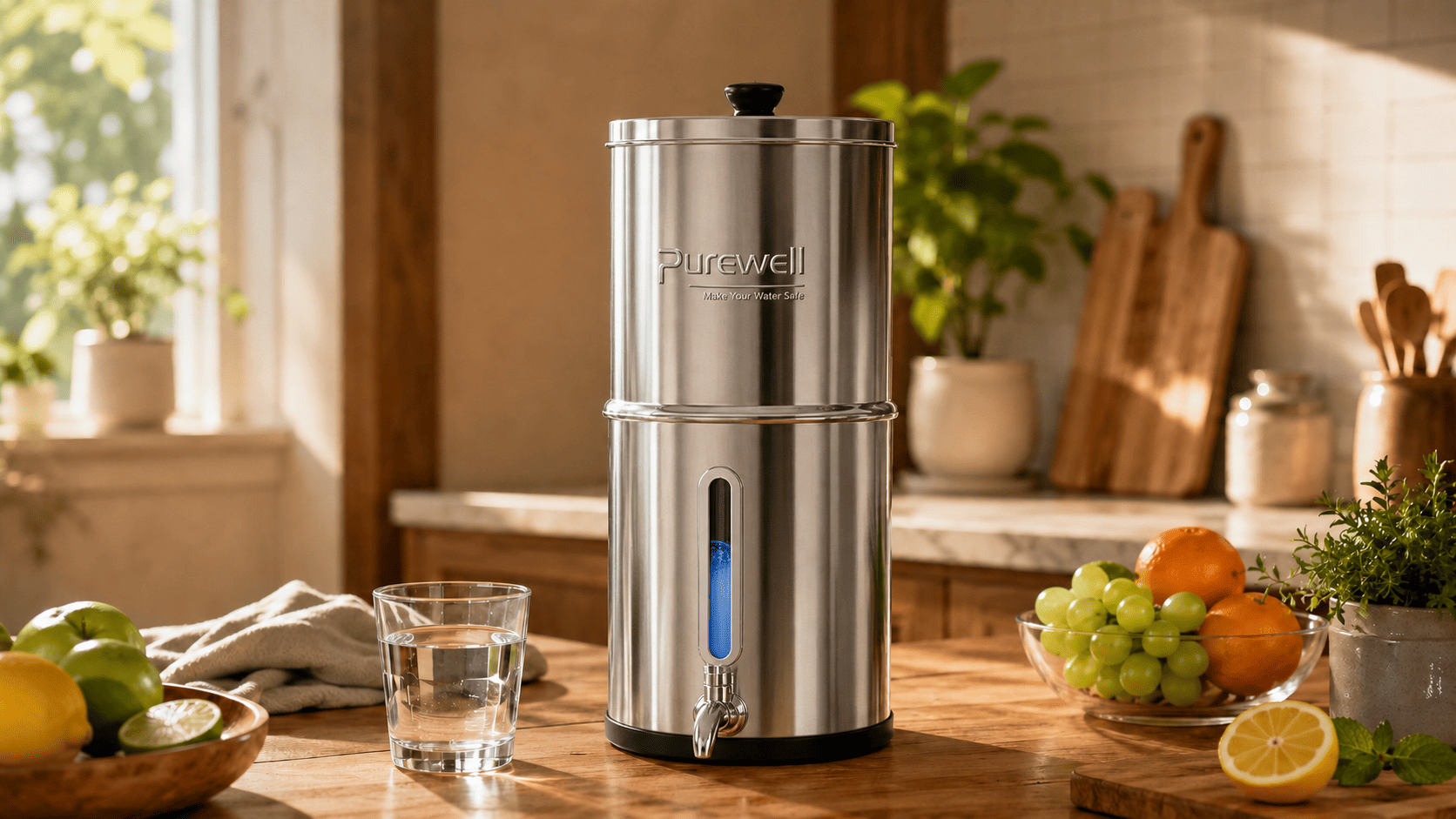
Purewell’s K Series 2.25 Gallon system is recommended for approximately three to five people. It uses two core filters, has a built-in viewing window, and measures about 22 centimeters in diameter by 66 centimeters high with the stand installed. (Purewell)
It is more suitable when filtered water is used for several purposes throughout the day. The larger chamber can reduce refill frequency, although buyers should measure the full countertop and cabinet clearance before ordering.
Compare Filter Types and Filtration Goals
The filter configuration is more important than the appearance of the stainless steel chambers.
CDC explains that filter performance depends on factors such as pore size, the size of the substance, and the way substances interact with the filtration media. It also warns buyers to check the label for the specific substances a filter is designed to address.
Activated Carbon
Activated carbon is commonly used to address selected taste, odor, and chlorine concerns.
NSF/ANSI 42 is associated with aesthetic effects such as chlorine, taste, and odor. Certification to this standard should not automatically be interpreted as proof of lead, PFAS, fluoride, bacteria, or every other possible reduction claim.
Hollow-Fiber Ultrafiltration Membranes
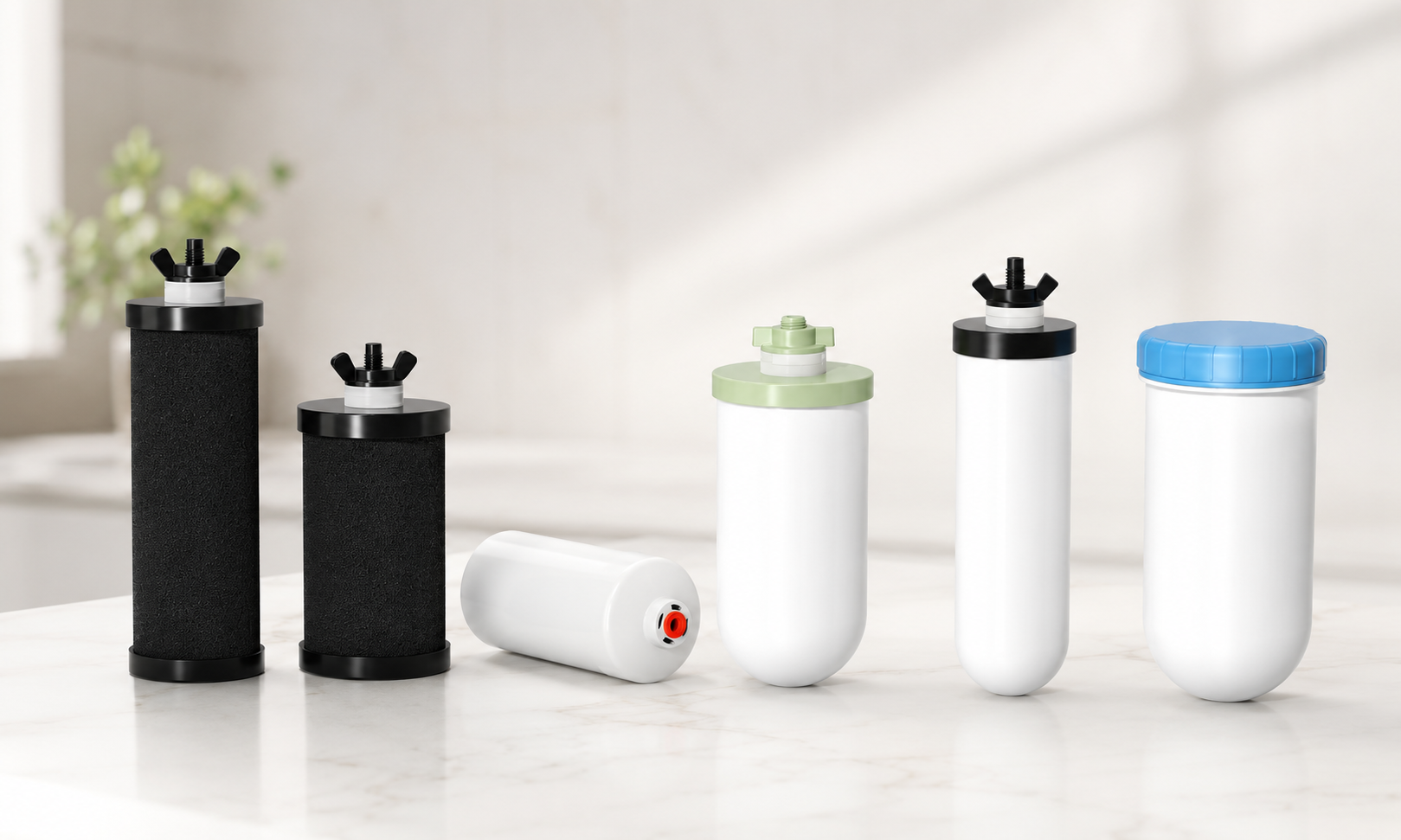
Some Purewell K, SS, and BO Series filters combine activated carbon with hollow-fiber ultrafiltration media.
The listed Purewell K Series options use a nominal 0.01-micron UF structure alongside additional filtration media. The standard K Series filter is designed for everyday filtration, while alternative configurations add fluoride-reduction or alkaline material. These filters are not designed to reduce total dissolved solids. (Purewell)
Pore size alone should not be used to infer every chemical-reduction capability. Chemical claims should be checked against the exact product documentation.
Ceramic Filters
Ceramic filter surfaces may help intercept applicable suspended particles and can sometimes be cleaned according to the manufacturer’s instructions.
A washable surface does not mean the filter can be used indefinitely. Internal media can still reach its rated capacity, and damaged or cracked ceramic elements must be replaced.
Specialty Filter Media
Some families may want a filter configuration designed for a specific concern, such as fluoride, PFAS, alkaline output, or TDS reduction.
These terms are not interchangeable:
-
Fluoride reduction refers to a specific reduction function.
-
PFAS reduction should be supported by applicable test documentation.
-
Alkaline media is intended to change water characteristics such as pH.
-
TDS reduction lowers measurable dissolved solids but does not, by itself, prove that water is safe or unsafe.
Purewell’s SS Series currently offers square-filter configurations for everyday chlorine reduction and selected fluoride, PFAS, or alkaline functions. Its SF Series uses one filter at a time and offers TDS-reduction, alkaline, or fluoride-reduction configurations. (Purewell)
Always confirm the exact configuration selected at checkout.
Understand Certifications and Test Reports
A certification number should be read according to its actual scope.
NSF/ANSI 42
This standard commonly covers specified aesthetic effects such as chlorine, taste, and odor.
NSF/ANSI 53
This standard applies to certified reduction claims involving specified contaminants with recognized health effects. Certification must be checked for the exact listed claim.
NSF/ANSI/CAN 372
This standard addresses lead content in components that contact drinking water. It does not, by itself, prove that a filter removes lead already present in the source water.
Purewell maintains a document page containing applicable NSF material evaluations, lead-content documents, and third-party performance reports. The company also notes that each document applies only to the product, component, sample, and test conditions identified in that file. (Purewell)
Before buying, check:
-
Model or component number
-
Tested filter configuration
-
Contaminant or material evaluated
-
Test volume
-
Laboratory
-
Date
-
Whether the document covers a component or complete system
Why System Material Matters
The chamber material affects cleaning, durability, weight, appearance, and long-term countertop use.
Purewell’s current family-size K, SS, SF, and BO gravity systems list 304 stainless steel as their main chamber material. (Purewell)
When comparing construction, check:
-
Chamber material
-
Interior coatings
-
Welds and seams
-
Spigot material
-
Washers and seals
-
Stand stability
-
Replacement-part availability
-
Cleaning instructions
Do not assume that “stainless steel” alone describes every water-contact component. Review the full product specification and applicable material documents.
Check Filter Quantity and Flow Rate
Two systems with the same chamber capacity can have different filter structures.
One-Filter Systems
Purewell’s SF Series 2.25 Gallon system uses one compatible SF Series filter at a time. This can simplify filter installation, but replacement capacity and flow depend on the selected SF filter. (Purewell)
Two-Filter Systems
The K Series 2.25 Gallon, SS Series, and BO Series systems use two compatible core filters together.
Purewell currently publishes maximum rates of up to four gallons per hour for the K Series 2.25 Gallon configuration, up to 2.5 gallons per hour for the SS Series, and approximately 2.38 gallons per hour for the BO Series under their stated two-filter conditions. Actual flow can decline with water level, source-water quality, sediment, use, and maintenance. (Purewell)
Do not compare headline flow rates without checking:
-
Number of filters installed
-
Whether the rate is maximum or typical
-
Upper-chamber water level
-
Condition of the filters
-
Source-water clarity
-
Filter configuration
Look for Practical Everyday Features
A family water filter should be easy to use correctly.
Water-Level Visibility
With a two-chamber system, it can be difficult to know how much water remains below.
Adding a full upper chamber when the lower chamber is already full can cause water to escape at the chamber seam. A built-in water-level window helps users check the lower chamber before refilling.
Current Purewell K, SS, SF, and BO family systems include an integrated viewing window. (Purewell)
Countertop Clearance
Measure both total height and refill clearance.
The system may fit beneath a cabinet but still be difficult to refill if there is not enough space to remove the lid or pour water into the upper chamber.
Stand Height
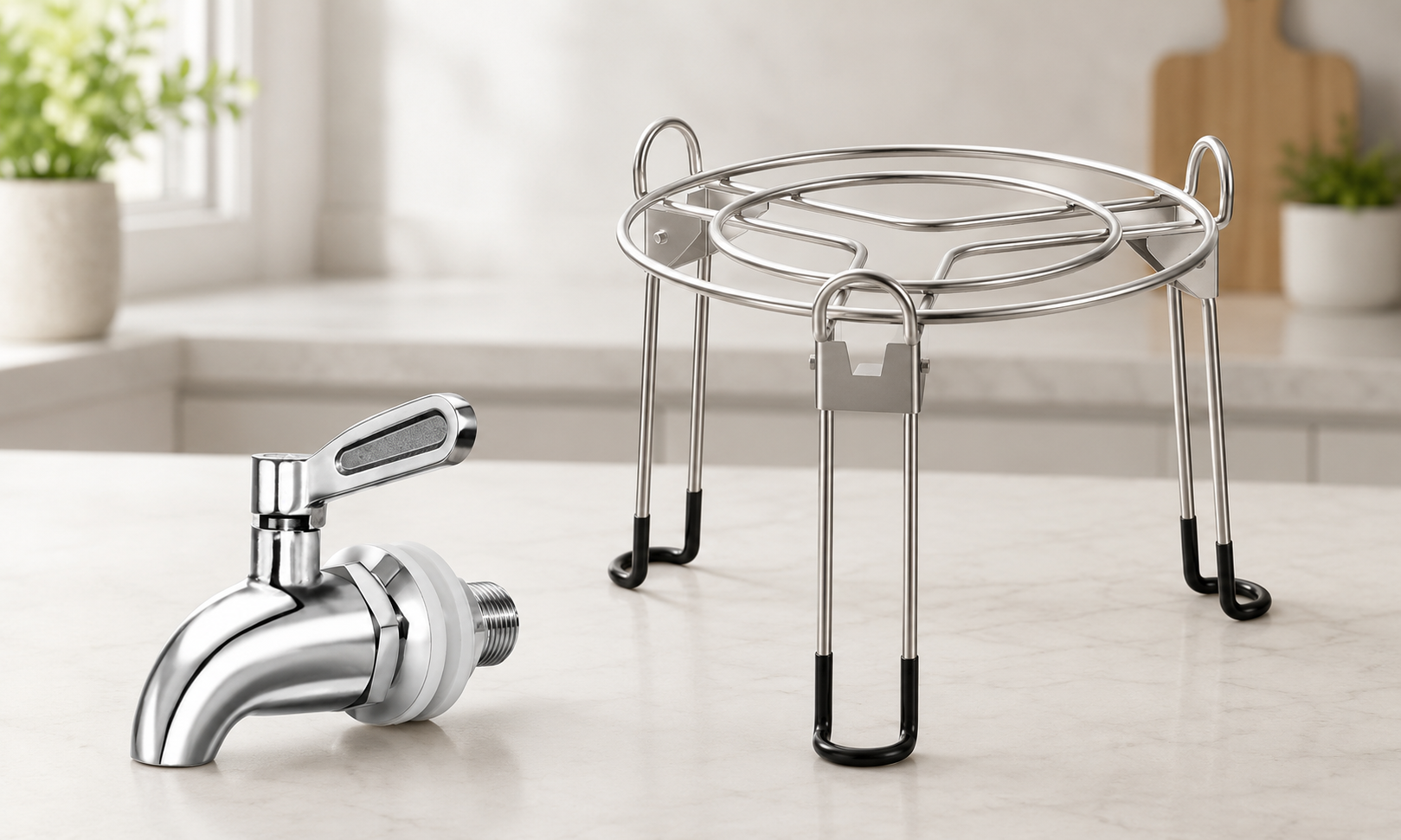
A stand provides clearance beneath the spigot for glasses and pitchers. Check that the stand is stable and that the total installed height fits the intended location.
Filter Preparation
Many carbon filters require flushing before first use. Purewell instructs users of its current K, SS, and BO configurations to flush the filters and discard the initial filtered-water batch. (Purewell)
Calculate the Long-Term Ownership Cost
The system price is only part of the cost.
Before purchasing, compare:
-
Number of filters included
-
Price of a complete replacement set
-
Rated gallon capacity
-
Calendar-based replacement guidance
-
Availability of replacements
-
Optional specialty filters
-
Cleaning and storage requirements
-
Shipping costs
Rated capacity is a maximum under the manufacturer’s stated conditions, not a guaranteed result for every household. Sediment, source-water quality, daily volume, maintenance, and filter configuration can shorten actual service life.
Also confirm whether capacity is stated:
-
Per filter
-
Per pair
-
Per box
-
For the complete configuration
A 2.25-gallon Purewell K Series system, for example, requires both filters from a two-filter box to be installed together. (Purewell)
Which Purewell Gravity Water Filter Is Best for Your Family?
Best Compact Choice: K Series 1.0 Gallon
Choose this when countertop space is the main concern and the system will serve one or two people.
Best suited for: apartments, couples, single users, small RV kitchens.
Best Balanced Choice: K Series 1.5 Gallon
Choose this when you want more capacity without the full height and width of a 2.25-gallon system.
Best suited for: two or three people, couples with higher daily use, compact family kitchens.
Best General Family Choice: K Series 2.25 Gallon
Choose this when three to five people will regularly use filtered water for drinking, cooking, coffee, and reusable bottles.
Best suited for: most family kitchens, frequent guests, higher daily demand.
Best for Square-Filter Options: SS Series 2.25 Gallon
Choose this when the family prefers the SS Series square-filter structure and wants to compare its specific chlorine, fluoride, PFAS, or alkaline configurations.
Best suited for: households with a clearly identified filtration priority and matching documentation. (Purewell)
Best for a Single-Filter Setup: SF Series 2.25 Gallon
Choose this when the household prefers a single replaceable filter and one of the available TDS-reduction, fluoride-reduction, or alkaline configurations matches its goal.
Best suited for: buyers prioritizing a one-filter system structure. (Purewell)
Best for a BO-Specific Compound Filter: BO Series 2.25 Gallon
Choose this when the household wants the BO Series multi-layer filter structure and understands that its replacement elements are specific to the BO Series.
Best suited for: families that prefer the BO filter configuration and will use BO-compatible replacements. (Purewell)
Common Gravity Water Filter Buying Mistakes
Choosing Capacity Only by Household Size
Family size is a starting point, not a complete calculation. Daily cooking and bottle-filling habits can matter more.
Assuming More Filtration Stages Always Means Better Water
The number of stages does not tell you whether a filter addresses the substance present in your water.
Confusing NSF/ANSI 372 With Lead Reduction
NSF/ANSI/CAN 372 concerns lead content in water-contact components, not automatic lead removal from source water.
Ignoring Replacement Compatibility
K, SS, SF, and BO filters may use different shapes, quantities, and mounting structures. Confirm the product series and item number.
Forgetting to Measure Cabinet Clearance
A system can fit on the countertop but still be inconvenient to refill.
Relying on Taste as a Safety Test
CDC notes that harmful germs and chemicals may not change the taste, smell, or appearance of water.
Final Buying Checklist
Before choosing the best gravity water filter for your family, confirm:
Water Source
-
Public tap water, private well, rainwater, or outdoor source
-
Available water report or test results
-
Specific filtration priorities
Household Use
-
Number of users
-
Estimated daily filtered-water demand
-
Drinking, cooking, pets, and reusable bottles
-
Normal and guest usage
System
-
Chamber capacity
-
Total installed dimensions
-
Filter quantity
-
Maximum published flow
-
Water-level visibility
-
Spigot and stand clearance
Filter
-
Exact filter model
-
Documented reduction claims
-
Certification scope
-
Rated capacity
-
Replacement price
-
Availability
-
Cleaning and flushing requirements
Long-Term Fit
-
Maintenance effort
-
Countertop space
-
Filter tracking
-
Replacement reminders
-
Customer support and installation resources
Summary: What Is the Best Gravity Water Filter for a Family?
The best family gravity water filter is the one that matches the household’s real water use and identified filtration needs.
For Purewell buyers, the K Series provides the clearest capacity progression:
-
1.0 gallon: one to two people
-
1.5 gallons: two to three people
-
2.25 gallons: three to five people
For many families, the K Series 2.25 Gallon is the most versatile starting point because it combines family-size storage, two-filter operation, 304 stainless steel chambers, and built-in water-level visibility. Smaller households may find the 1.0- or 1.5-gallon models easier to place and refill.
Families with a specific filtration priority can also compare the SS, SF, and BO Series, but the exact filter configuration and supporting report should guide the choice.
Do not select a system based only on size, stage count, pore size, or marketing language. Start with the water, then choose the filter.
Frequently Asked Questions
What size gravity water filter is best for a family of four?
A 2.25-gallon system is generally a practical starting point for a family of four. Actual suitability depends on how much filtered water the household uses for drinking, cooking, pets, and bottles.
Is a 1.5-gallon gravity filter large enough for a family?
It may suit two to three people or a family with moderate filtered-water use. Larger or higher-use households may need more frequent refilling.
Is stainless steel better for a gravity water filter?
Stainless steel can provide a durable, easy-to-clean chamber structure. Buyers should still inspect the full system, including the spigot, seals, stand, coatings, and material documentation.
How many filters should a family gravity system use?
It depends on the model. Purewell’s K Series 1.0 Gallon uses one core filter, while the 1.5- and 2.25-gallon K Series systems use two. The SF Series 2.25 Gallon uses one SF filter at a time. (Purewell)
Does a larger system filter water faster?
Not necessarily. Flow depends on filter quantity, filter design, water level, source-water quality, filter condition, and maintenance—not only chamber capacity.
Does a gravity filter reduce TDS?
Many carbon and ultrafiltration gravity filters are not designed to lower TDS. The Purewell K and SS core filters specifically state that they are not TDS-reduction filters. The SF Series offers a separate TDS-reduction configuration. (Purewell)
Can I choose a filter based on taste and odor?
Taste and odor can help identify an aesthetic preference, but they cannot confirm water safety. Review the water report or test results and match the filter to the specific concern.
How often should the filters be replaced?
Follow the exact filter’s rated gallon capacity, calendar guidance, and condition-based instructions. Replacement may be required sooner when flow cannot be restored, the filter is damaged, or source-water quality shortens its service life.
Find the Right Purewell System for Your Home
Compare capacities, filter structures, and compatible replacement options before choosing your household system.
Explore Purewell Gravity Water Filter Systems, review the Home Water Filter collection, or compare compatible Replacement Water Filters.
Before selecting a filter configuration, review the corresponding Purewell Test Reports and Certificates.