
Hard Water vs. Soft Water: What Is the Difference?
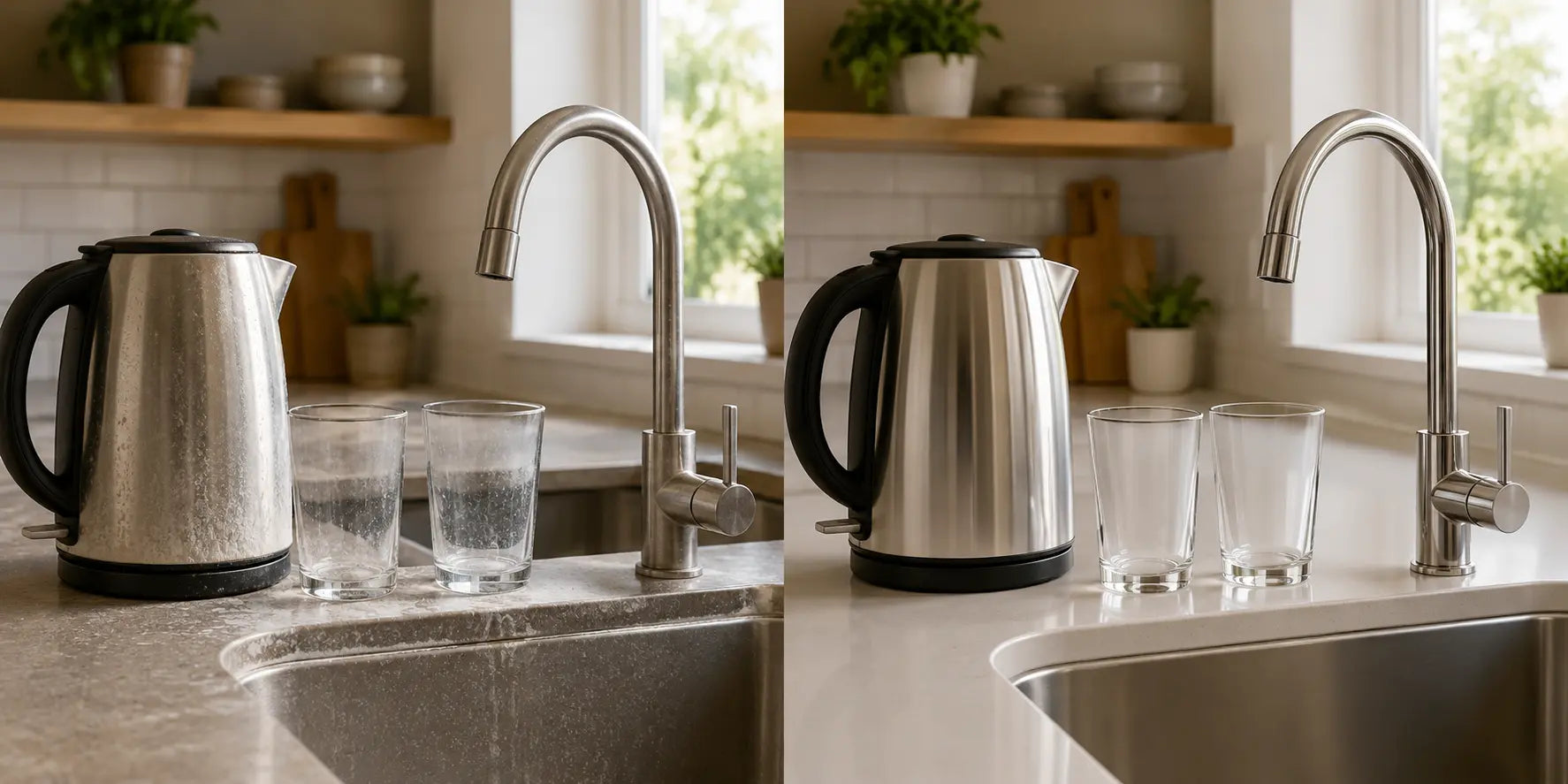
White spots on drinking glasses, scale around a faucet, and soap that does not lather easily are often blamed on “bad water.” In many homes, however, these signs are caused by hard water rather than unsafe water.
Hard water contains higher concentrations of dissolved calcium and magnesium. Soft water contains lower concentrations of these hardness minerals, either naturally or after treatment. The difference can affect cleaning, plumbing fixtures, water heaters, and the type of water-treatment system that makes sense for your home. (USGS)
The terms can also create confusion. Soft water is not automatically purified water, and a standard drinking-water filter does not necessarily soften hard water. A gravity filter, reverse osmosis system, and ion-exchange water softener perform different functions.
This guide explains the practical differences between hard and soft water, how to determine your water hardness, and when to consider a gravity water filter, reverse osmosis system, or dedicated water softener.
Table of Contents
-
What is hard water?
-
What is soft water?
-
Hard water vs. soft water at a glance
-
Is hard water safe to drink?
-
How hard water affects a home
-
Benefits and trade-offs of soft water
-
Hardness vs. TDS
-
How to test your water hardness
-
Can a gravity water filter soften water?
-
Reverse osmosis vs. water softening
-
How to choose the right treatment method
-
Summary
-
Frequently asked questions
What Is Hard Water?
Water becomes hard as it moves through soil and rock containing mineral compounds. Calcium and magnesium dissolve into the water and become the main contributors to hardness.
The U.S. Geological Survey defines water hardness as the amount of dissolved calcium and magnesium in water. Hardness is normally reported in milligrams per liter as calcium carbonate, written as mg/L as CaCO₃. (USGS)
Hard water may produce familiar household signs:
-
White or chalky deposits around faucets
-
Spots on glasses and dishes
-
Scale inside kettles or coffee makers
-
Mineral buildup on showerheads
-
Reduced soap lather
-
Soap residue on sinks or bathtubs
-
Scale in water heaters or plumbing
These signs can suggest hardness, but they do not show the exact hardness level or determine whether other substances are present.
Water Hardness Levels
The USGS uses the following general classification:
| Hardness as CaCO₃ | Classification |
|---|---|
| 0–60 mg/L | Soft |
| 61–120 mg/L | Moderately hard |
| 121–180 mg/L | Hard |
| More than 180 mg/L | Very hard |
These ranges are practical classifications rather than safety thresholds. Water above 180 mg/L may create more noticeable scale, but the number alone does not determine whether the water is safe to drink. (USGS)
What Is Soft Water?
Soft water contains relatively low concentrations of calcium and magnesium.
Water can be naturally soft because of the geology surrounding its source. It can also be softened by a treatment system.
A conventional ion-exchange water softener removes calcium and magnesium ions and replaces them with sodium or potassium ions. The system periodically regenerates using a salt solution so the ion-exchange material can continue operating. (US EPA)
This process addresses hardness, but it should not be confused with general filtration.
A water softener is primarily designed to reduce hardness minerals. It is not automatically designed to reduce chlorine, microorganisms, PFAS, lead, pesticides, or every other possible drinking-water concern. The exact capabilities depend on the complete treatment system and its verified claims.
Hard Water vs. Soft Water at a Glance
| Comparison Point | Hard Water | Soft Water |
|---|---|---|
| Calcium and magnesium | Higher concentration | Lower concentration |
| Scale formation | More likely | Less likely |
| Soap lather | May require more soap | Usually lathers more easily |
| Spots on dishes | More common | Less common |
| Water-heater scale | More likely | Reduced after effective softening |
| Taste | May have a mineral character | May taste different after softening |
| Sodium or potassium | Not added by hardness itself | May increase after ion-exchange treatment |
| Automatically safe to drink | No | No |
| Automatically contaminant-free | No | No |
The most important point is that hardness and water safety are separate questions.
A hard-water sample can meet drinking-water requirements while still causing scale. Soft water can still contain germs or chemicals unrelated to calcium and magnesium.
Is Hard Water Safe to Drink?
Hard water is not generally treated as a health concern at the concentrations normally found in drinking water.
The World Health Organization has not established a health-based guideline value for hardness because it is not considered a health concern at levels ordinarily found in drinking water. Calcium and magnesium in water can also contribute a portion of dietary mineral intake.
This does not mean that every source of hard water is safe.
Hardness tells you primarily about dissolved minerals. It does not confirm the absence of:
-
Harmful microorganisms
-
Nitrate
-
Arsenic
-
Lead
-
PFAS
-
Pesticides
-
Industrial chemicals
-
Other substances of local concern
Similarly, soft water is not automatically safer than hard water.
The CDC advises households not to rely only on taste, odor, or appearance when evaluating water. Harmful substances may produce no obvious sensory change, while some substances that mainly create taste or odor may not represent the same type of health risk.
For public tap water, review the local water-quality report. Private-well owners should test their water through an appropriate laboratory and choose treatment according to the actual results.
How Hard Water Affects Your Home
For most households, the main reasons to treat hard water are practical rather than medical.
Scale on Fixtures and Appliances
When hard water is heated or evaporates, some dissolved minerals can form solid deposits.
Scale may appear on:
-
Faucets
-
Showerheads
-
Glass shower doors
-
Kettles
-
Coffee makers
-
Humidifiers
-
Dishwashers
-
Water-heating surfaces
-
Plumbing interiors
USGS documentation notes that calcium and magnesium can precipitate as mineral solids, particularly on hot heat-exchange surfaces. (USGS)
The severity depends on hardness level, temperature, water use, equipment design, and maintenance.
Reduced Soap Performance
Hardness minerals react with soap, which can reduce lather and create residue.
This may lead households to use more soap or detergent for washing, bathing, and cleaning. Both USGS and CDC identify poor soap lather and scale as common signs of hard water.
Spots on Glassware
When droplets of hard water dry, dissolved minerals can remain on the surface.
A dishwasher rinse aid or manual drying may reduce visible spots, but these steps do not change the water hardness.
Scale in Drinking-Water Equipment
Hard water may also leave deposits in kettles, coffee machines, ice makers, and some water-treatment devices.
Follow each appliance manufacturer’s descaling schedule. Installing a drinking-water filter without checking whether it reduces hardness may not prevent scale.
What Are the Benefits of Soft Water?
Softening can provide several practical household advantages when hardness is high enough to create problems.
Less Mineral Scale
Effective softening reduces calcium and magnesium before the water reaches fixtures and appliances. This can limit hardness-related scale throughout the treated plumbing system. (US EPA)
Easier Soap Lather
With fewer hardness minerals, soap can lather more easily and may leave less mineral-related residue.
Easier Fixture Cleaning
Reduced scale can make faucets, shower doors, sinks, and other surfaces easier to maintain.
Whole-Home Treatment
A point-of-entry softener can treat water before it is distributed to showers, washing machines, water heaters, and other household outlets.
This is a major difference from most countertop filters, which treat only the water dispensed from that device.
Are There Trade-Offs to Water Softening?
A water softener is useful for the right problem, but it is not maintenance-free.
Salt and Regeneration
Traditional cation-exchange softeners require salt or potassium and periodically regenerate. Regeneration uses water and produces a discharge stream containing removed hardness minerals and regenerant ions. (US EPA)
Efficiency varies between systems, so compare regeneration frequency, salt use, water use, and sizing before purchase.
Sodium May Increase
A sodium-based ion-exchange softener replaces calcium and magnesium with sodium. As a result, the sodium concentration in the treated water may increase. (US EPA)
Households that monitor sodium intake should review the water hardness, softener settings, finished-water sodium level, and advice from an appropriate healthcare professional. Some homes soften only the hot-water supply or keep a separate unsoftened drinking-water tap, depending on their plumbing and treatment plan.
Softened Water Is Not Fully Purified
Softening does not mean that all dissolved substances have been removed. Calcium and magnesium are exchanged for other ions rather than simply filtered out of the water.
A separate drinking-water treatment system may still be appropriate when the household has another documented water-quality concern.
Hardness Is Not the Same as TDS
Hardness and total dissolved solids are related, but they are not interchangeable.
Water Hardness
Hardness mainly measures dissolved calcium and magnesium, expressed as an equivalent concentration of calcium carbonate. (nrtwq.usgs.gov)
Total Dissolved Solids
TDS is a broader measurement of dissolved material in water. It can include calcium, magnesium, sodium, potassium, chloride, sulfate, and other dissolved ions.
A water sample can therefore have:
-
High TDS and high hardness
-
High TDS but relatively low hardness
-
Moderate TDS with noticeable hardness
-
Low hardness after sodium-based softening without a proportionate removal of all dissolved solids
A TDS meter does not identify which substances are present. It also cannot confirm that water is safe or unsafe.
CDC notes that TDS testing indicates how much dissolved material is present but not the complete identity or health significance of that material.
How Can You Test Water Hardness?
Testing is more reliable than estimating hardness from spots or taste.
Check Your Water Utility Information
Some utilities publish hardness data in their annual report, website, or customer information pages. When it is not listed, contact the utility and ask for the average hardness range in your service area.
Remember that household plumbing and local distribution conditions can affect what reaches the tap.
Use a Hardness Test Kit
Home test strips or drop-count titration kits can provide a useful estimate.
Follow the instructions carefully and confirm whether the result is expressed in:
-
Milligrams per liter
-
Parts per million
-
Grains per gallon
-
Calcium carbonate equivalent
A screening kit is helpful for sizing or adjusting a softener, but laboratory testing may be more appropriate when treatment decisions involve additional contaminants.
Test Private-Well Water
Private wells can change over time and may contain substances unrelated to hardness.
CDC recommends that private-well owners use a state-certified laboratory and test at least annually for total coliform bacteria, nitrate, TDS, and pH, with additional testing based on local risks.
A hardness result should be considered alongside the complete water analysis.
Can a Gravity Water Filter Soften Hard Water?
Most standard gravity filters do not soften hard water.
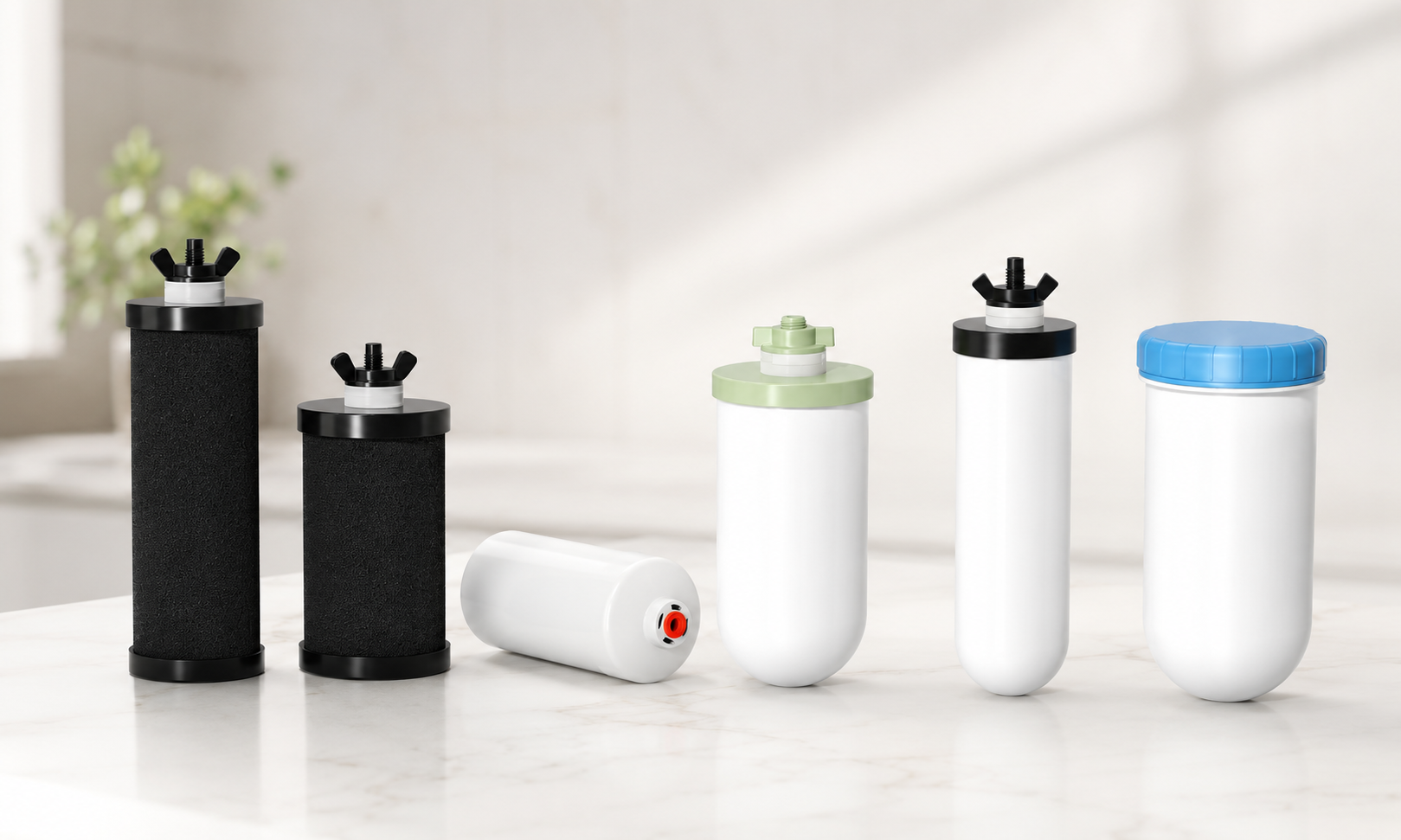
Gravity filters commonly use activated carbon, ceramic material, hollow-fiber membranes, adsorption media, or combinations of these technologies. They may be designed for sediment, chlorine taste and odor, or other specifically documented reduction claims.
However, dissolved calcium and magnesium are small ions. Standard carbon and ultrafiltration configurations generally allow these dissolved minerals to remain in the water.
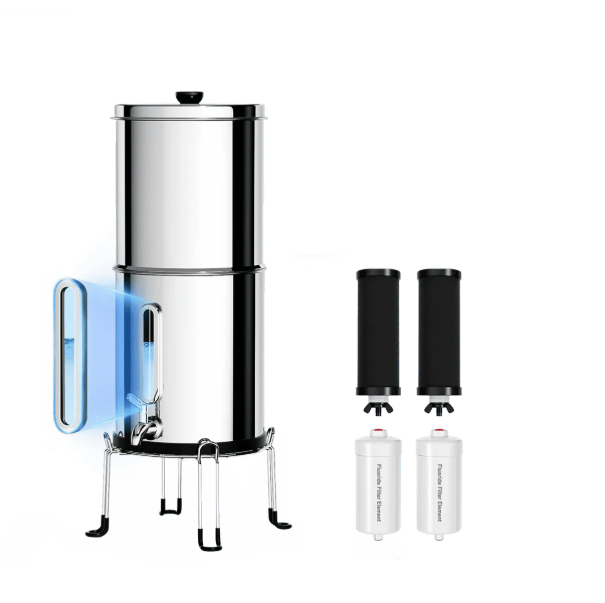
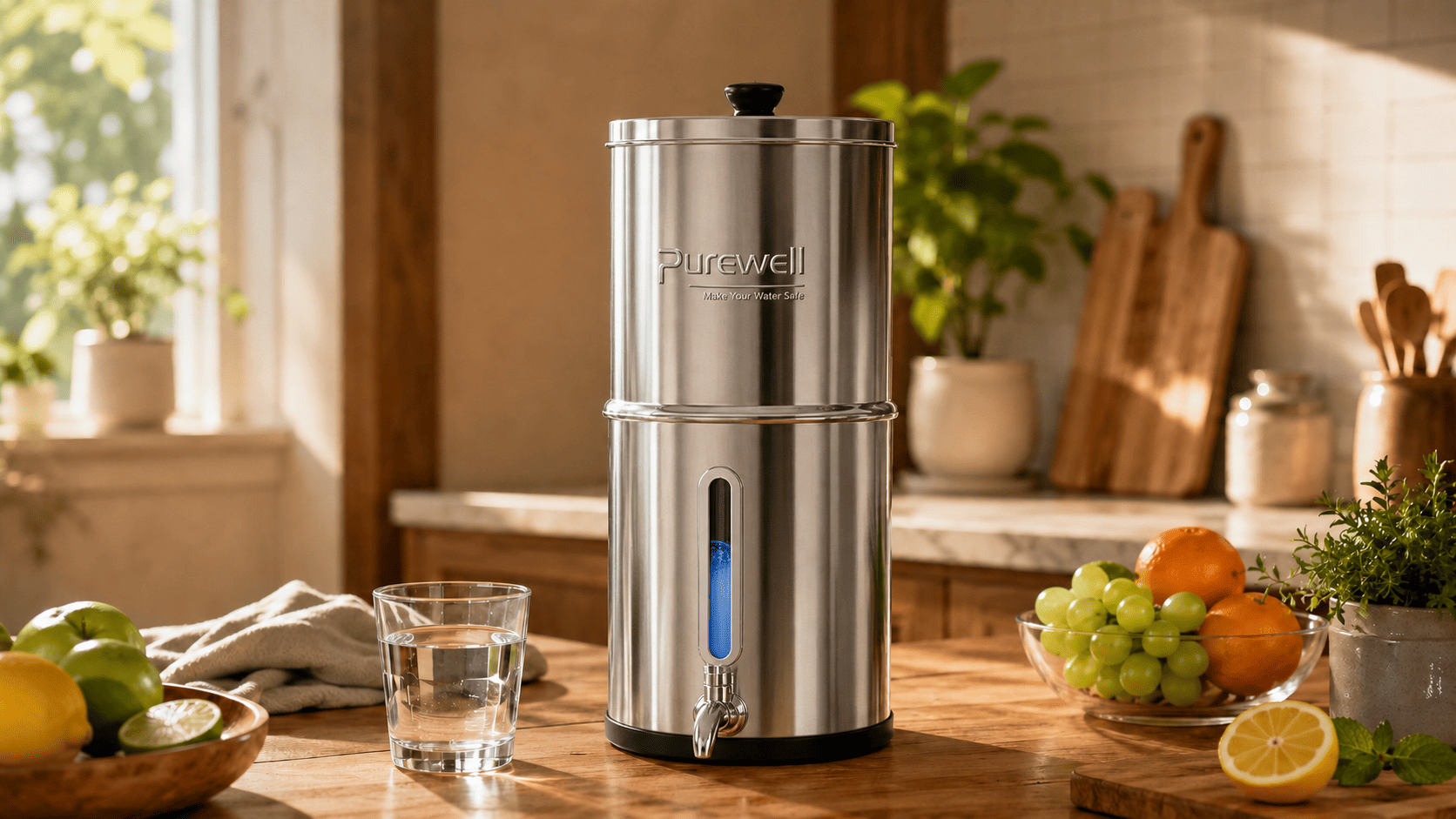
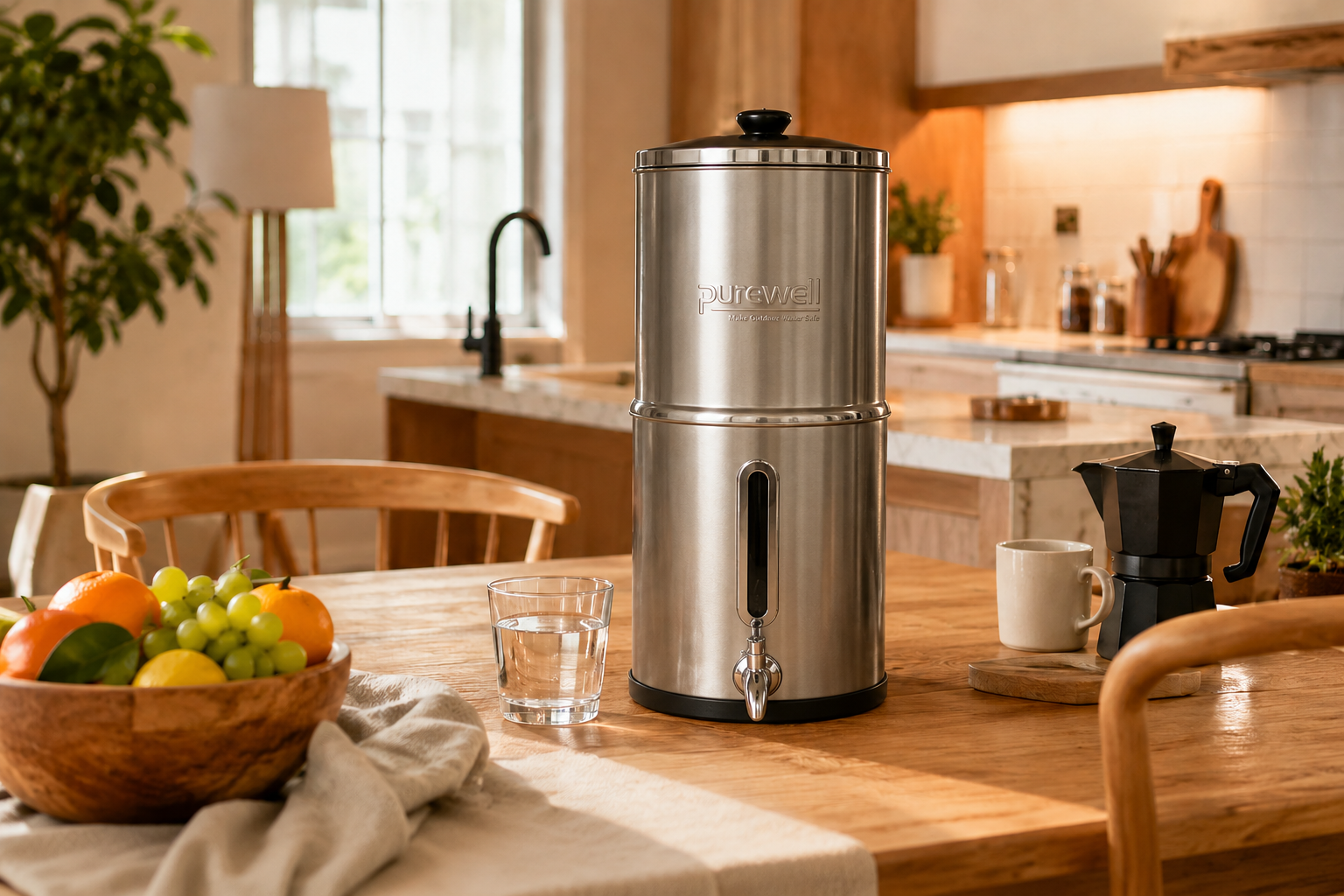
Purewell’s standard K Series gravity-filter configurations explicitly state that they are not designed to reduce TDS. The SF Series product guidance also explains that standard configurations do not soften hard water by themselves. (Purewell)
When a Gravity Filter Still Makes Sense
A gravity water filter may still be useful in a hard-water home when the main goal is:
-
Improving selected taste or odor characteristics
-
Reducing applicable sediment
-
Addressing claims documented for the exact filter
-
Keeping drinking and cooking water available without plumbing
-
Operating without electricity
The household should simply understand that scale may remain because the hardness minerals have not been removed.
What About a TDS-Reduction Gravity Filter?
Purewell offers a specific SF Series TDS-reduction filter. That model is designed to reduce TDS, unlike the standard K Series carbon and UF configurations. (Purewell)
A limited-capacity countertop TDS-reduction filter should still not be treated as a direct substitute for a whole-home water softener. It treats only the water passing through that filter and does not protect showers, washing machines, water heaters, or the rest of the plumbing system.
Can Reverse Osmosis Reduce Water Hardness?
Reverse osmosis can reduce many dissolved ions, including calcium and magnesium, in the water that passes through the membrane.
CDC identifies calcium and magnesium among the substances that some RO systems may reduce, while emphasizing that buyers must check the exact product label and verified claims.
RO uses pressure to move water across a selective membrane. A portion of the source water becomes treated permeate, while rejected dissolved substances leave in a concentrated stream.
Purewell’s RO filtration guide explains that RO membranes are designed to reduce many dissolved salts, ions, and substances that contribute to TDS. (Purewell)
Advantages of RO for Hard-Water Drinking Water
A point-of-use RO system may be appropriate when a household wants:
-
Lower hardness in drinking and cooking water
-
Reduced TDS
-
Treatment for specific documented dissolved substances
-
Countertop or under-sink point-of-use treatment
-
An alternative to drinking sodium-softened water
Limitations of RO
A countertop RO system treats only the water processed by the unit. It will not prevent scale throughout the entire home.
Hard source water may also increase scaling pressure on an RO membrane, which can affect flow and filter life. Follow the manufacturer’s feed-water limits and maintenance instructions.
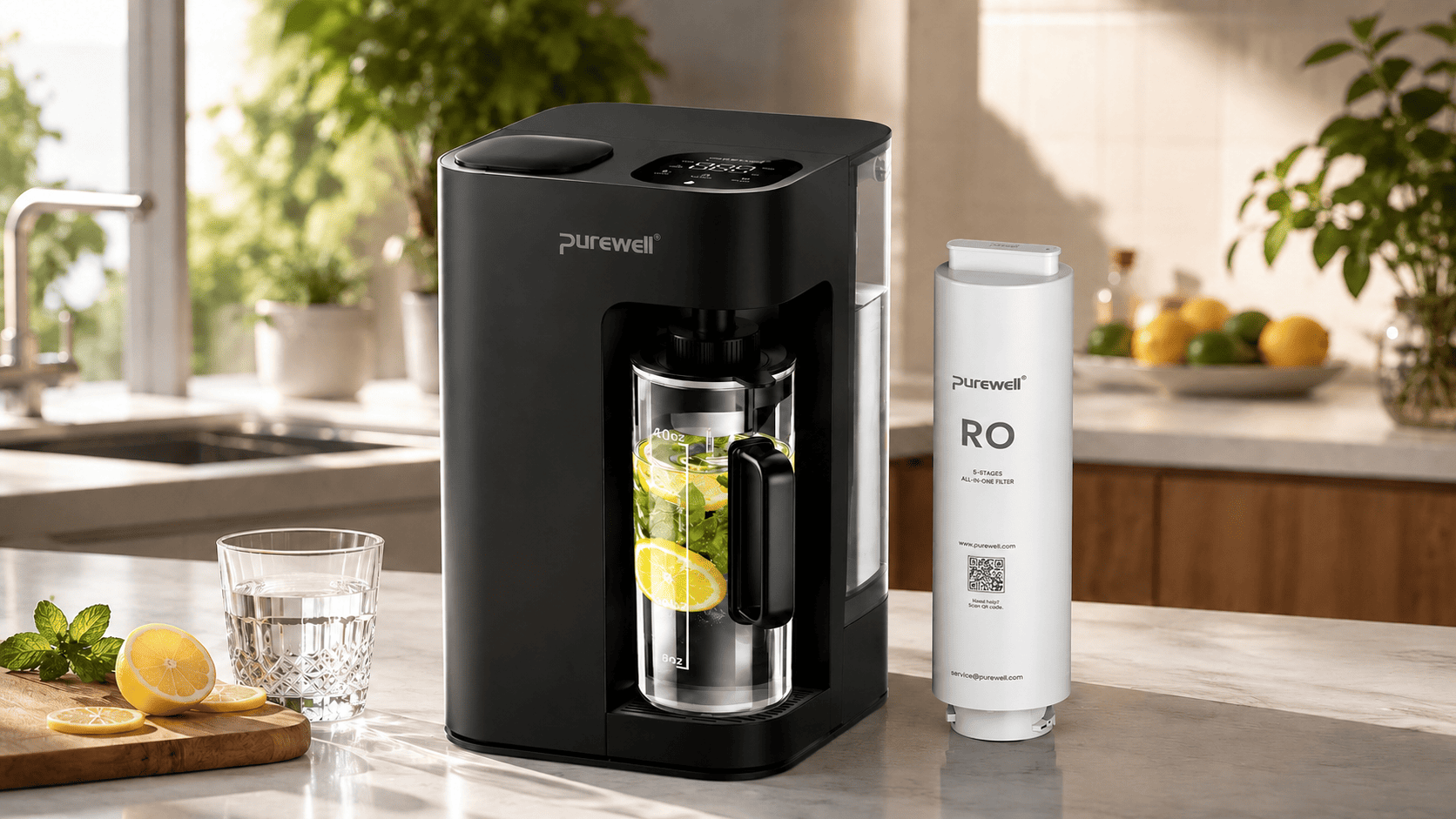
For example, Purewell’s C05 countertop RO system is designed for municipal tap water and advises against source water above its stated TDS limit because high dissolved-solids levels may reduce flow and shorten service life. (Purewell)
Reverse Osmosis vs. a Water Softener
RO and water softeners overlap in one area—both may reduce calcium and magnesium—but they are designed for different household roles.
| Household Goal | Better Starting Option | Why |
|---|---|---|
| Reduce scale throughout the home | Whole-home water softener | Treats water before it reaches plumbing and appliances |
| Improve soap lather | Whole-home water softener | Removes hardness minerals from household water |
| Lower TDS in drinking water | RO system | Membrane reduces many dissolved ions |
| Treat only drinking and cooking water | Countertop or under-sink RO | Point-of-use treatment |
| Address taste or odor without reducing hardness | Gravity carbon filter | Simpler treatment when hardness removal is not the goal |
| Operate without electricity or plumbing | Gravity system | Uses gravity rather than pressure or an electric pump |
| Address both whole-home scale and drinking-water TDS | Softener plus point-of-use RO | Each system handles a different task |
A combined system is not always necessary. Choose treatment according to your measured hardness, source-water report, household goals, and available maintenance budget.
How to Choose the Right Water-Treatment Solution
Choose a Gravity Water Filter When:
-
Your main goal is not hardness reduction.
-
You want countertop drinking-water filtration.
-
You want a system that normally operates without electricity.
-
You cannot or do not want to modify plumbing.
-
The exact filter documentation matches your water concern.
Purewell’s K Series gravity systems are available in multiple capacities and use compatible filter configurations for different household needs. These standard configurations are not designed to lower TDS or provide whole-home softening. (Purewell)
Choose a Countertop RO System When:
-
You want to reduce dissolved minerals in drinking water.
-
Lower TDS is an identified goal.
-
You need point-of-use rather than whole-home treatment.
-
The source water falls within the system’s operating requirements.
-
You are comfortable with electricity, filter changes, and concentrate water.
Purewell’s C05 countertop RO system combines an RO membrane with additional filtration, remineralization, TDS monitoring, and automatic pitcher filling without requiring permanent plumbing. (Purewell)
Choose a Whole-Home Water Softener When:
-
Scale is appearing throughout the house.
-
Soap performance is a major concern.
-
Water-heating equipment and plumbing need hardness protection.
-
Testing confirms that calcium and magnesium are the main issue.
-
You are prepared to maintain and regenerate the system.
Consider More Than One Treatment Stage When:
-
The home has both significant hardness and another drinking-water concern.
-
A whole-home softener is needed for scale, while point-of-use treatment is desired for drinking water.
-
Private-well testing identifies several unrelated treatment needs.
Treatment order and compatibility can affect performance. For complex well-water conditions, consult a qualified water-treatment professional rather than assembling systems solely from online recommendations.
Common Hard-Water Myths
“Hard Water Is Contaminated Water”
Not necessarily. Hardness describes calcium and magnesium concentration, not overall water safety. WHO does not set a health-based limit for ordinary drinking-water hardness.
“Soft Water Is Purified Water”
No. Ion-exchange softening primarily exchanges hardness minerals for sodium or potassium. Other substances may remain.
“Any Water Filter Will Remove Hardness”
No. Standard carbon and UF gravity filters generally do not remove dissolved hardness minerals.
“A TDS Meter Tells Me Whether Water Is Safe”
No. TDS indicates the general amount of dissolved material but does not identify every substance or its health significance.
“RO and Water Softeners Do the Same Job”
No. A water softener is usually designed for whole-home hardness control. RO is generally a point-of-use membrane process for reducing dissolved substances in drinking and cooking water.
Summary: Which Water Is Better?
Neither hard water nor soft water is universally “better” for every household.
Hard water contains more calcium and magnesium. It is not generally considered a health concern at normal drinking-water levels, but it can create scale, spots, and soap-performance problems. Softened water reduces these household effects, although ion-exchange treatment may increase sodium or potassium and does not remove every contaminant.
The right treatment depends on the problem you want to solve:
-
Choose a water softener for whole-home hardness and scale.
-
Choose reverse osmosis when you want to reduce hardness minerals and TDS in drinking water.
-
Choose a gravity water filter when your goal is convenient countertop filtration rather than softening.
-
Combine technologies only when water testing and household needs justify it.
Start with a water report or test result. Then choose the treatment system whose documented function matches the water—not the one with the longest feature list.
Frequently Asked Questions
What is the main difference between hard water and soft water?
Hard water contains higher concentrations of dissolved calcium and magnesium. Soft water contains lower concentrations, either naturally or after treatment. (USGS)
Is hard water bad for your health?
WHO does not consider hardness a health concern at levels normally found in drinking water and has not established a health-based guideline value. This does not confirm that every hard-water source is free from unrelated contaminants.
Is hard water bad for appliances?
Hardness minerals can form scale on heated surfaces and inside equipment. The impact depends on hardness level, water temperature, equipment design, and maintenance. (USGS)
Does activated carbon soften water?
No. Activated carbon is not normally designed to remove the dissolved calcium and magnesium responsible for hardness.
Does a Purewell gravity water filter remove hardness?
Standard Purewell K Series gravity filters are not designed to reduce TDS or soften hard water. Certain SF Series filters are designed for TDS reduction, but a countertop system does not provide whole-home softening.
Does reverse osmosis make hard water soft?
RO can reduce calcium, magnesium, and other dissolved ions in the water it treats. A countertop or under-sink RO system provides point-of-use treatment rather than whole-home softening.
Is softened water the same as low-TDS water?
Not necessarily. Sodium-based softening exchanges calcium and magnesium for sodium, so hardness can decrease without removing all dissolved material.
Should I buy an RO system or a water softener?
Choose a softener when the primary goal is reducing scale throughout the home. Choose RO when the goal is reducing dissolved minerals and other documented substances in drinking and cooking water. Some households use both for different purposes.
How do I know whether my water is hard?
Check information from your utility, use a hardness test kit, or have the water analyzed by a laboratory. Private-well owners should perform broader testing rather than measuring hardness alone.
Learn More About Your Water-Treatment Options
Understanding the problem should come before choosing the product.
Explore Purewell gravity systems when your priority is convenient countertop filtration, or compare countertop RO options when reducing dissolved minerals and TDS is part of your drinking-water goal.
Editorial Note
This article provides general educational information. Water composition and treatment requirements vary by location and source. Review local water-quality information or laboratory results before selecting a treatment system. Product performance depends on the exact model, filter configuration, operating conditions, maintenance, and verified certification or test scope.